
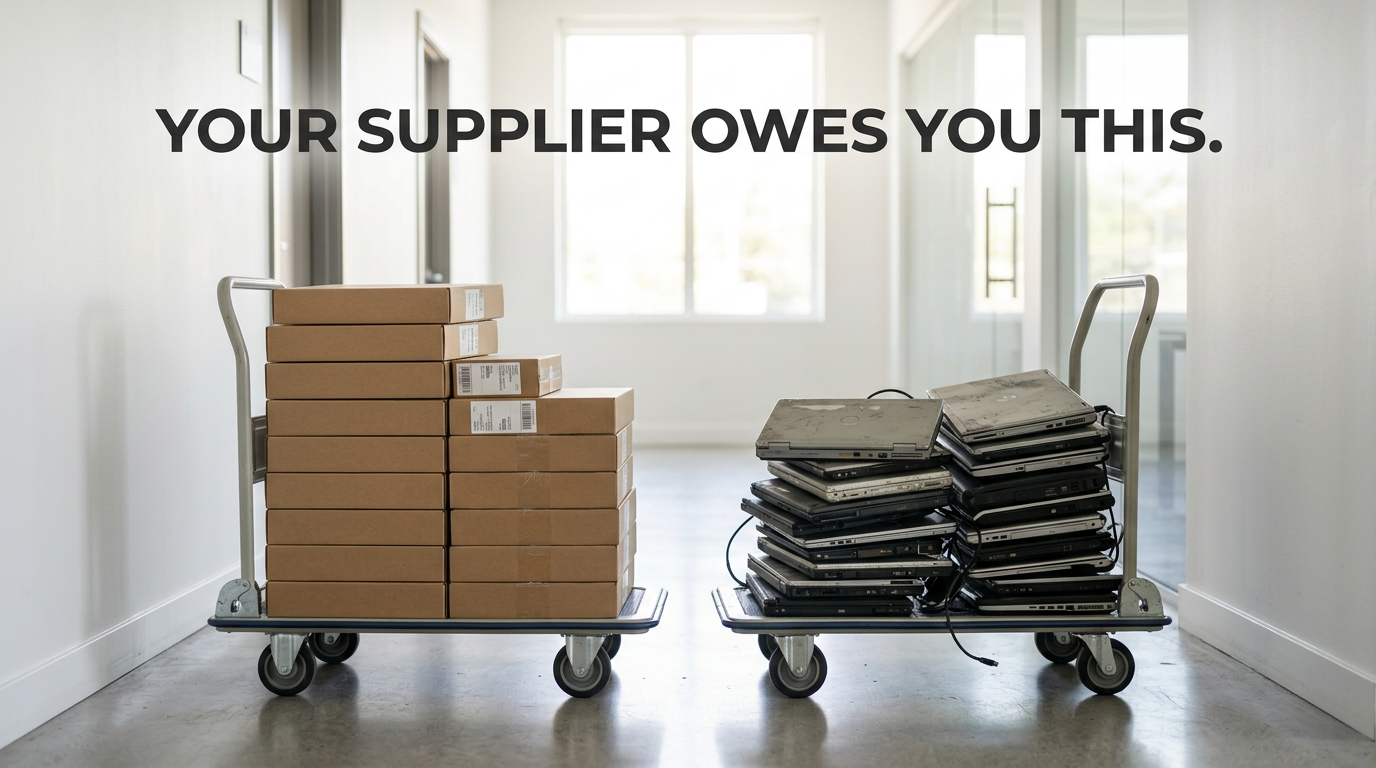
Buy a pallet of new laptops for your office and, in most cases, the supplier is legally obliged to take your old ones away, treat them and recycle them, free of charge.
Almost no business asks. Most pay someone else to do a job their supplier already owes them.
That right comes from the WEEE Directive, and it is the single most useful thing in the regulations for a business that buys equipment. Here is what the rules actually say, stripped of the jargon.
What WEEE means, in one sentence
WEEE stands for Waste Electrical and Electronic Equipment. In practice, it means anything that used to run on mains power, a battery or a charger, and has now reached the end of its life.
The test is simpler than most people expect. If it had a plug, a battery or a cable, it is WEEE. That catches far more than IT equipment. Fridges, kettles, vending machines, air conditioning units, emergency lighting, power tools, medical devices, laboratory instruments and vape pens all qualify.
The UK implements this through the Waste Electrical and Electronic Equipment Regulations 2013, which sit on top of the original European directive. Britain leaving the EU did not remove the obligation. The regulations remain UK law.
Fourteen categories, and why they all apply to business
The regulations sort electrical equipment into fourteen categories. Some of them carry the word “household” in the name, which causes endless confusion.
That naming is misleading. All fourteen categories cover both household and non-household equipment. A commercial dishwasher in a hotel kitchen sits in the same category as a domestic one. The category describes the type of product, not who owns it.
What changes between household and business equipment is not the category. It is who pays, and that is where the useful part begins.
The obligation your suppliers carry
The regulations split business WEEE into two types, and the distinction decides who foots the bill.
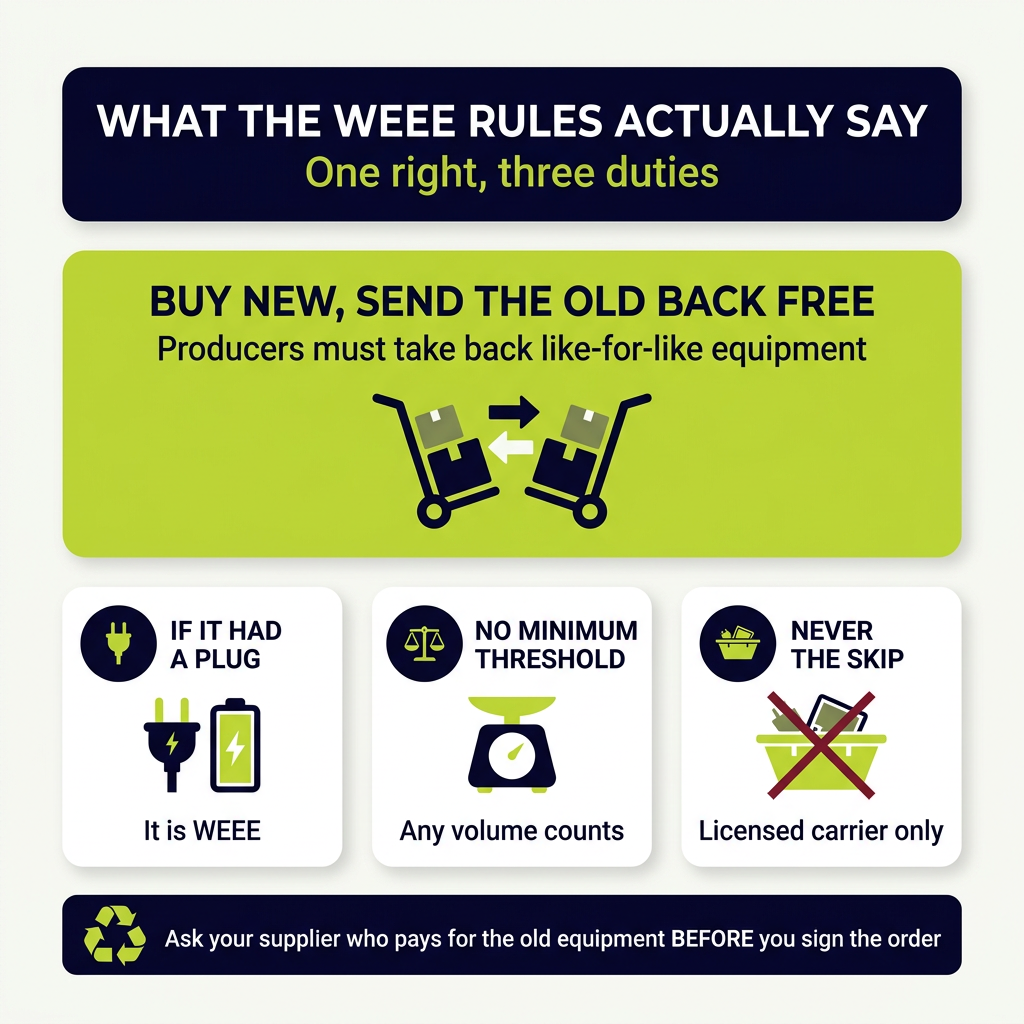
Historical WEEE is equipment placed on the market before 13 August 2005. When a producer supplies you with new equipment, they are obliged to take away the equivalent old equipment, and treat and recycle it, at no cost to you. This is a like-for-like right. Buy ten new monitors, and ten old monitors can go back.
New WEEE is equipment placed on the market after that date. Here, the financing responsibility sits with the producer who supplied it, unless you agreed something different in writing at the point of purchase.
That last clause is the one to watch. Many suppliers include terms that shift end-of-life responsibility onto the buyer. It is lawful, and it is easy to miss in a procurement document.
The practical action: before you sign your next equipment order, ask the supplier in writing what happens to the old kit and who pays. Ask before you buy. Afterwards, you have nothing to bargain with.
What producers and distributors have to do
You may also be the obligated party. Businesses fall into scope more often than they realise.
You count as a producer if you manufacture electrical equipment under your own brand, import it into the UK, rebrand someone else’s equipment as your own, sell directly to UK customers from overseas, or run an online marketplace that lets non-UK sellers reach UK households.
There is no minimum threshold. Placing any electrical equipment on the UK market brings you into scope. What volume changes the route:
- Under 5 tonnes a year: register directly with your environmental regulator as a small producer
- 5 tonnes or more a year: join an approved Producer Compliance Scheme
Distributors who sell electrical equipment to consumers carry a separate duty regardless of size. You must offer free like-for-like take-back of household WEEE, and you must publish information about separate collection on your premises, your website or your catalogue.
If your business sells anything with a plug, even as a sideline, this applies to you.
What it means for the equipment you throw away
Whether or not you are a producer, you are a waste producer, and duty of care under the Environmental Protection Act 1990 applies in full.
That means four things, every time:
- Use a licensed carrier. Check their upper tier waste carrier registration on the Environment Agency’s public register before anything leaves site.
- Keep the paperwork. Keep waste transfer notes for at least two years, and hazardous waste consignment notes for at least three.
- Treat data-bearing equipment separately. Laptops, phones, servers, copiers and anything with storage in it need a documented destruction route and a certificate. WEEE compliance and data compliance are two different obligations on the same box.
- Separate the hazardous items. Fridges, air conditioning units, fluorescent tubes and batteries all have their own rules and cannot simply go in with mixed WEEE.
Where businesses most often get caught out
Assuming small volumes do not count. There is no threshold below which WEEE becomes ordinary waste. One broken monitor is still WEEE.
Skips. Electrical items put in a general skip during an office move or a refit are the single most common breach we see. It is fast, it is convenient, and it is not lawful.
Forgetting the embedded equipment. Air conditioning, emergency lighting, alarm panels, door entry systems and vending machines are all WEEE, and all get overlooked because nobody thinks of them as devices.
Confusing recycling with data destruction. A recycler certifying that a laptop was recycled has told you nothing about what happened to the drive inside it.
Not claiming the free take-back. Back to where we started. The right exists. It is rarely used.
Frequently asked questions
What is the WEEE Directive?
The WEEE Directive is the European law governing how waste electrical and electronic equipment is collected, treated and recycled, implemented in Britain through the Waste Electrical and Electronic Equipment Regulations 2013. It makes producers responsible for financing the end-of-life treatment of equipment they place on the market, and it requires that WEEE is kept out of general waste and landfill.
Does the WEEE Directive still apply in the UK after Brexit?
Yes. The obligations were retained in UK law through the WEEE Regulations 2013, which remain in force. Leaving the EU changed some reporting arrangements but did not remove the duty on producers, distributors or businesses disposing of electrical equipment.
Can my business put electrical items in a general waste skip?
No. WEEE must be separated from general waste and sent to an approved authorised treatment facility via a licensed carrier. Putting electrical equipment in a general skip breaches your duty of care under the Environmental Protection Act 1990, and it is the most common breach during office moves and refurbishments.
Does my supplier have to take away my old equipment?
Often, yes. When a producer supplies you with new business equipment, they are obliged to take back, treat and recycle the equivalent old equipment free of charge, on a like-for-like basis. For equipment placed on the market after 13 August 2005, the position depends on what was agreed at purchase, so check your contract and ask before you order.
Do I need to register as a WEEE producer?
If you manufacture, import, rebrand or sell electrical equipment into the UK, yes, and there is no minimum threshold. Businesses placing under 5 tonnes a year on the market can register directly with their environmental regulator as a small producer. At 5 tonnes or more, you must join an approved Producer Compliance Scheme.
The bottom line
Most businesses treat the WEEE Directive as a cost. Read properly, a good part of it is a right.
Ask your equipment suppliers what they take back and who pays, before you sign. Keep electrical items out of the skip. Treat the data separately from the hardware. Those three habits cover most of the obligation and most of the opportunity.
Priority WEEE collects, treats and recycles business electrical equipment nationally, with full waste transfer documentation, data destruction certification and approved treatment facility routing. Book a free waste review, and we will tell you what your suppliers should already be taking off your hands.
