
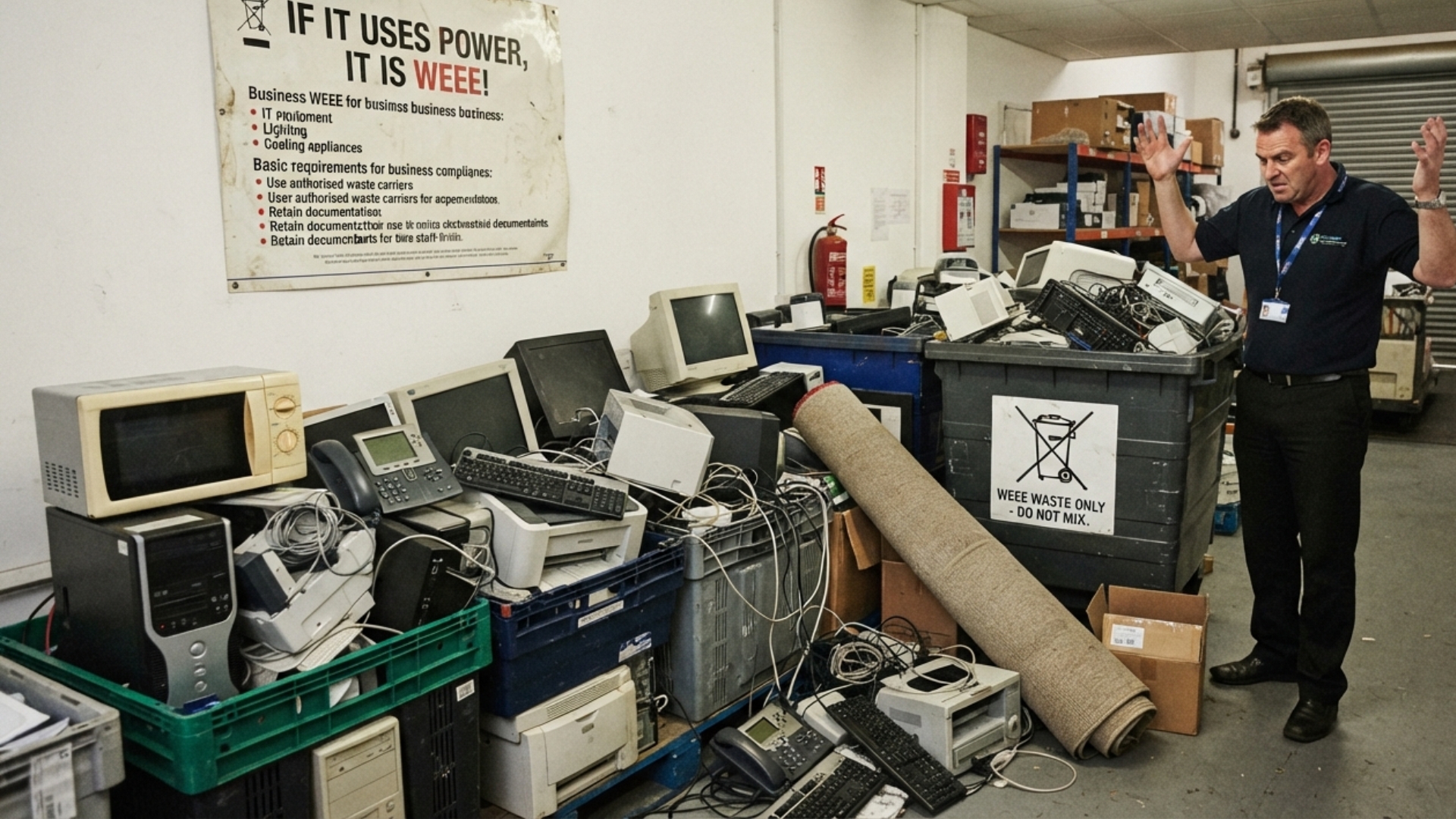
Somewhere in your building there is a cupboard, a shelf, or an entire storeroom that has become the retirement home for electricity. Old laptops nobody logged out of. A printer that jammed once too often in 2022. Boxes of cables for equipment no one can name. The kettle that tripped the fuse board and the monitor with the cracked corner.
Every business has this graveyard, and it exists because electrical waste sits in a strange psychological gap: too obviously valuable to bin, too complicated to deal with, and never anyone’s actual job. So it accumulates, which is fitting, because e-waste is the world’s fastest-growing waste stream, with the UN’s Global E-waste Monitor putting the global pile above 60 million tonnes a year and rising.
The rules, the risks, and the surprisingly good economics of doing this properly all fit in one article. Here is the working guide.
The Definition That Fits On A Post-It
WEEE stands for Waste Electrical and Electronic Equipment, and the legal definitions run to categories and annexes. The operational definition, the one we give every customer, fits on a sticky note: if it uses power, it is WEEE when you throw it away.
Plug, battery, cable, solar cell: any of them qualifies the item. That covers the obvious IT estate, computers, servers, monitors, phones, printers, and keeps going into territory that surprises people: kettles and microwaves from the staff kitchen, desk fans, power tools, tills and card machines, fridges and water coolers, fluorescent tubes and lamps, electric signage, extension leads and the great cable mountain itself, right up to commercial and industrial machinery of any size. If it uses power, we can help, and more to the point, the law expects you to treat it as a separate stream.
Why the separation? Electricals are a contradiction in a beige case. They contain hazardous components, lithium batteries with a documented fire habit, mercury in older lamps, refrigerant gases in cooling equipment, lead in older boards and glass, and simultaneously valuable materials: steel, copper, aluminium, gold in connectors, and rare earth metals like the neodymium in every hard drive magnet. General waste treatment is designed for neither. The WEEE regime exists to keep the hazards contained and pull the value back into manufacturing, and it works only when the equipment arrives through the right door.
What The Law Actually Asks Of A Business
Strip the regulations to what an office, shop, school, or factory must actually do, and it is four habits.
Keep WEEE out of general waste. The skip and the wheelie bin are not lawful destinations for anything with a circuit board. Collectors increasingly detect and reject contaminated loads, and batteries in general waste are now a leading cause of bin lorry and depot fires.
Use authorised carriers, and check them. Anyone collecting your WEEE needs waste carrier registration, verifiable in one minute on the Environment Agency public register. Ours is CBDU292438. The “free collection, mate” van that fills eBay and the layby in equal measure is the industry’s fly-tipping pipeline, and traced dumped WEEE comes home to the business that produced it.
Keep the paperwork. Waste documentation for every collection, retained for inspection, exactly as with any controlled stream. Where data-bearing equipment is involved, destruction certificates join the file, a subject with its own guide on this blog, because drives deserve their own paranoia.
Deal with data before disposal, not after. The cheapest moment to think about the hard drives is before the pallet leaves. The most expensive moment is after a tribunal asks where they went.
None of this is burdensome once a route exists. A scheduled or on-call collection, the right containers on site, and the file does the rest.
The Part Nobody Expects: Your E-Waste Might Be Worth Something
Here is where WEEE differs cheerfully from every other waste stream in your business: some of it has residual value, and a good provider treats that value as yours.
Reusable IT equipment can qualify for free collection, subject to quantity and age criteria, because refurbishment and resale fund the service. Beyond free, our IT asset management service turns better equipment into an actual revenue stream back to the business, a story our asset disposal guide tells in full.
Even true scrap pays its way. Shredded electronics yield steel, copper, aluminium, and rare earths back to smelters and manufacturers; our guide to what is inside your old electronics traces that recovery chain. Recoverable value offsets processing cost, which is why honest WEEE pricing is lower than businesses braced for hazardous-waste rates expect.
The one lever you control is segregation. Reusable kit kept apart from scrap, batteries out and boxed, lamps unbroken in proper containers, cables gathered rather than woven through everything: every hour of pre-sorting shows up on the quote. UN-approved containers for each stream, from lamp boxes to lockable 40-foot enclosures for the big producers, are part of the service.
What A Compliant WEEE Collection Looks Like
The process, from the customer’s chair, is short.
- Describe the pile. A free assessment scopes what you have: quantities, types, reusable versus scrap, data-bearing or not, access and containers needed. Photographs beat inventories; nobody expects you to know the model numbers.
- Get the right containers. Cages, pallets, lamp and battery boxes, or secured enclosures for ongoing streams, all UN-approved, matched to your site.
- Collection on a confirmed date. Mainland UK up to Glasgow and Edinburgh, average turnaround 5 to 7 working days, next-day where it is urgent, on tracked vehicles.
- Paperwork back. Transfer documentation, data destruction certificates where relevant, asset reports where kit went for reuse. File, and the graveyard is officially empty, lawfully.
Frequently Asked Questions About Business WEEE Disposal
What counts as WEEE?
Anything that used power: IT, appliances, tools, lamps, cooling equipment, machinery, cables. The post-it rule catches it all.
Can electricals go in the general bin?
No. WEEE is a separate stream by law, collected by authorised carriers with documentation. Batteries in general waste are a literal fire risk.
Is collection free?
Reusable IT can be, subject to quantity and age criteria, and better kit can earn money back. End-of-life mixed WEEE is priced, offset by material value.
What paperwork should we receive?
Transfer documentation every time, destruction certificates for data-bearing media, asset reports for reused equipment. Keep all of it.
Why is WEEE regulated separately?
Hazards in, value out: batteries, mercury, and refrigerants need containment, while steel, copper, and rare earths deserve recovery.
Where do you collect?
Mainland UK from Bedford, up to Glasgow and Edinburgh, typically inside 5 to 7 working days, next-day available, under licence CBDU292438.
Empty The Graveyard
The cupboard of dead electronics is the easiest compliance win in your building: one assessment, one collection, one folder of paperwork, and possibly a credit note where you expected an invoice.
Priority WEEE collects and recycles every kind of electrical waste for businesses across mainland UK, from single pallets to full site clearances, with free assessments and fast, tracked, documented collections. Call 0800 078 9580 or request a free review at priorityweee.co.uk, and give the retirement home for electricity the send-off it has been waiting for.
