
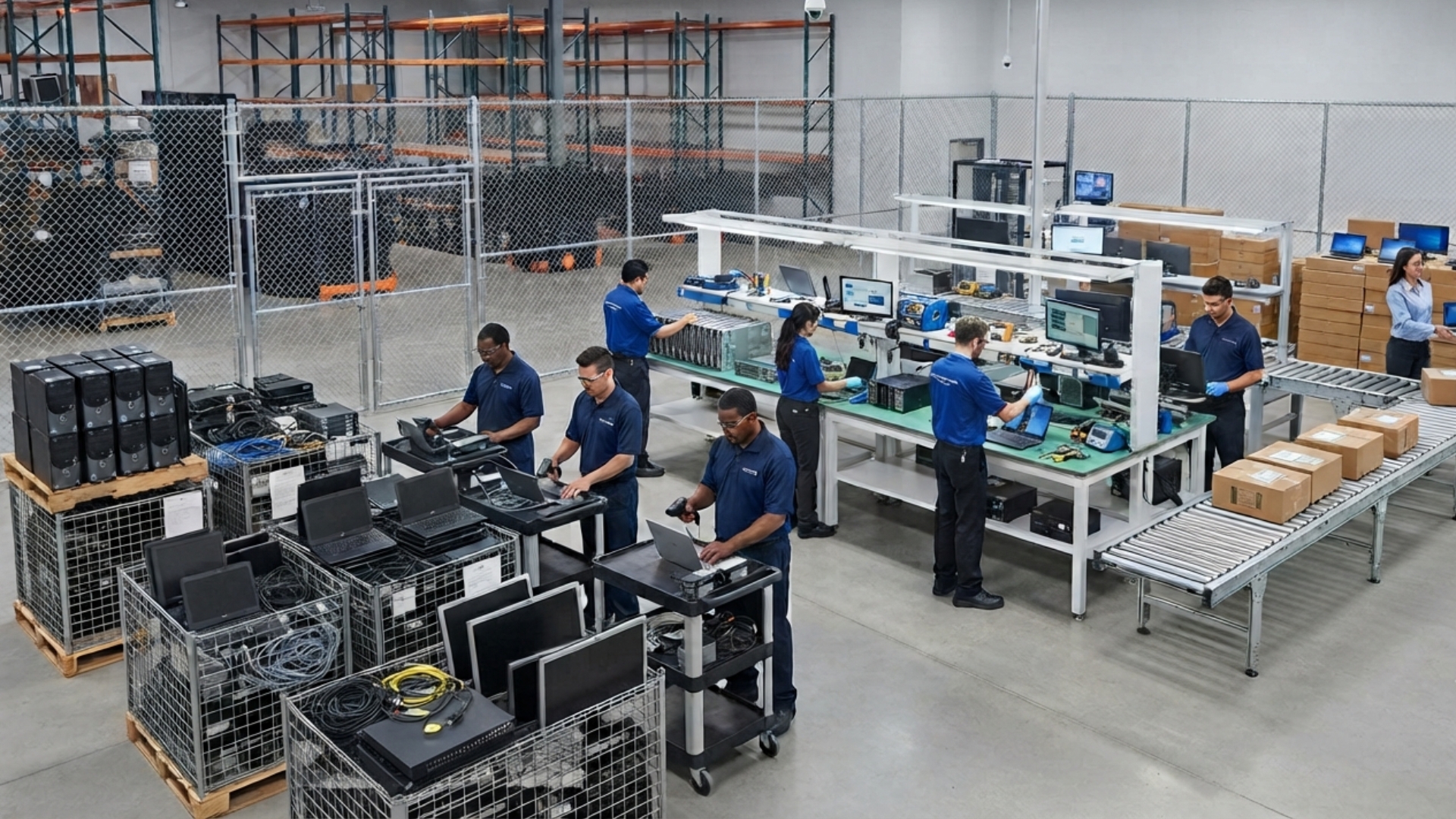
Every three to five years, the same scene plays out in businesses everywhere: a hundred perfectly functional laptops are stacked on a trolley to make room for their replacements, and someone signs a purchase order for the new fleet while the old one heads for a skip quote.
Look at that trolley the way an asset manager does, and the scene changes. Those machines cost perhaps £60,000 new. They boot, they run, and somewhere between a quarter and half of them would sell tomorrow in the refurbished market, where schools, charities, startups, and whole export markets buy exactly this stock. The trolley is not a waste on its way out; it is a line of credit nobody has drawn.
IT asset management, ITAD in the trade’s jargon, is the discipline of drawing it. Here is how it works, what your retired estate is realistically worth, and how the same process solves the compliance file at the same time.
The Hierarchy: Reuse Beats Recycling, And Pays Better
Sustainability policy and finance rarely agree as completely as they do here. The waste hierarchy puts reuse above recycling, and the resale market puts money on the same square.
A refurbished five-year-old laptop keeps every gram of its embodied manufacturing, the mined metals, the fabricated board, the assembled screen, in service for years more, which is why reuse is the waste-preventative measure regulators and ESG frameworks love. The same laptop fetches real money because demand for a good refurbished kit comfortably outruns supply.
The asset management process is built around sorting your estate along that hierarchy honestly:
- Grade A: refurbish and resell. Recent, working, cosmetically decent. Cleaned, tested, refurbished, and sold on, with the proceeds shared back to you, either as revenue to put toward new equipment or as the subsidy that makes the whole project cost neutral.
- Grade B: harvest. Older but organ-rich: good RAM, screens, PSUs, and caddies feed the refurbishment bench even when the whole unit will not sell.
- End of life: recycle. Shredded and separated for material recovery, steel, copper, aluminium, board metals, rare earths, the route our electronics-materials guide follows to the smelter. Nothing needs to go to landfill.
The blend across those grades is what decides the money, which brings us to the honest criteria.
When Recycling Is Free, And When It Earns
The phrase “free IT recycling” gets thrown around loosely in this industry, so here is the plain version of how it actually works.
Free collection is real and conditional. If your load contains enough reusable equipment, typically judged on minimum quantity and age criteria, the resale value funds the collection, and the service costs you nothing. A pallet of three-year-old laptops qualifies easily. Ten machines from the Windows 7 era do not, and anyone offering to take them “free” is answering a different question, usually one about scrap weight or worse.
Beyond free sits revenue. Larger volumes of newer kit flip the arrangement: the resale share becomes an actual payment back to the business, a genuine budget line toward the replacement fleet. Businesses running regular refresh cycles on managed contracts see this as a matter of routine rather than luck.
And mixed reality is quoted honestly. Most real estates are a blend: some resale, some harvest, some scrap, some CRT monitor found in a cupboard that costs money to treat properly. A free assessment prices the blend transparently, value offsetting cost, before anything moves. The variable you control is timing: equipment value decays like fruit, and the estate retired promptly at refresh is worth more than the same estate after two years in the storeroom, a false economy our WEEE basics guide files under the graveyard cupboard.
The Compliance Spine: Data First, Always
None of the value story works without the risk story being handled first, because a resold computer with a readable drive is not an asset recovered; it is a breach shipped.
The process therefore runs data-first, exactly as our data destruction guide sets out: drives and data-bearing media come out and are physically shredded, with certificates, before any device enters the resale lane. Serial-level recording where required, tracked vehicles and secure handling in between, and asset reports documenting what was reused, what was recycled, and what was destroyed.
That paper bundle, destruction certificates, asset reports, and waste documentation is the second product of asset management. It answers the auditor, the ISO assessor, the insurer, and the ESG questionnaire in one folder, and it turns the IT refresh from a compliance risk into a documented sustainability win the business can actually report: kit reused, tonnes recycled, landfill zero.
Making It Routine: The Managed Estate
The one-off clearance is the entry point, but the businesses extracting the most value run asset management as a standing arrangement, and the shape is worth copying.
Retired equipment accrues into secure on-site containment, lockable stores or supplied containers, rather than desk drawers and window sills. Collections run on schedule or on call, mainland UK up to Glasgow and Edinburgh, typically within 5 to 7 working days, next day when a project demands. Each cycle returns its certificates, reports, and remittances, and the estate’s whole lifecycle, deploy, retire, recover, closes in a loop the finance team can see.
Schools and multi-site groups add a wrinkle worth knowing: consolidated collections across sites, one paperwork chain, and the reuse revenue pooled where it helps most. And for the leavers-and-laggards problem, the odd machines that trickle out between refreshes, the same standing arrangement absorbs them without ceremony.
Frequently Asked Questions About IT Asset Management
Is old business IT worth anything?
Often, yes: laptops and desktops under five years, servers, networking, and good monitors all carry resale value that can fund collection or return revenue.
How does the process work?
Collect, destroy data media with certificates, grade, refurbish and resell the good, harvest the useful, recycle the rest, and report the lot.
When is collection free?
When quantity and age criteria mean resale funds. Newer volume flips to revenue; older mixed loads are quoted with value offsetting cost.
Is resale safe under GDPR?
Yes, because drives are shredded before anything sells. Value and risk live in different components, and the process separates them first.
What about an unsellable kit?
Material recovery: metals and rare earths back to manufacturing, landfill avoided, documentation throughout.
Who does this suit?
Any business refreshing IT: offices, schools, hospitals, retailers, from single pallets to national estates, with free assessments to start.
Draw The Credit Before It Expires
Somewhere in your building, retired IT is depreciating quietly toward zero when it could be funding its own successors. The difference between the two outcomes is one assessment and a collection date.
Priority WEEE runs IT asset management end to end: certificated data destruction, refurbishment and resale with value back to you, compliant recycling for the remainder, and paperwork that makes the auditor smile. Call 0800 078 9580 or request a free review at priorityweee.co.uk, and find out what the trolley is actually worth.
