
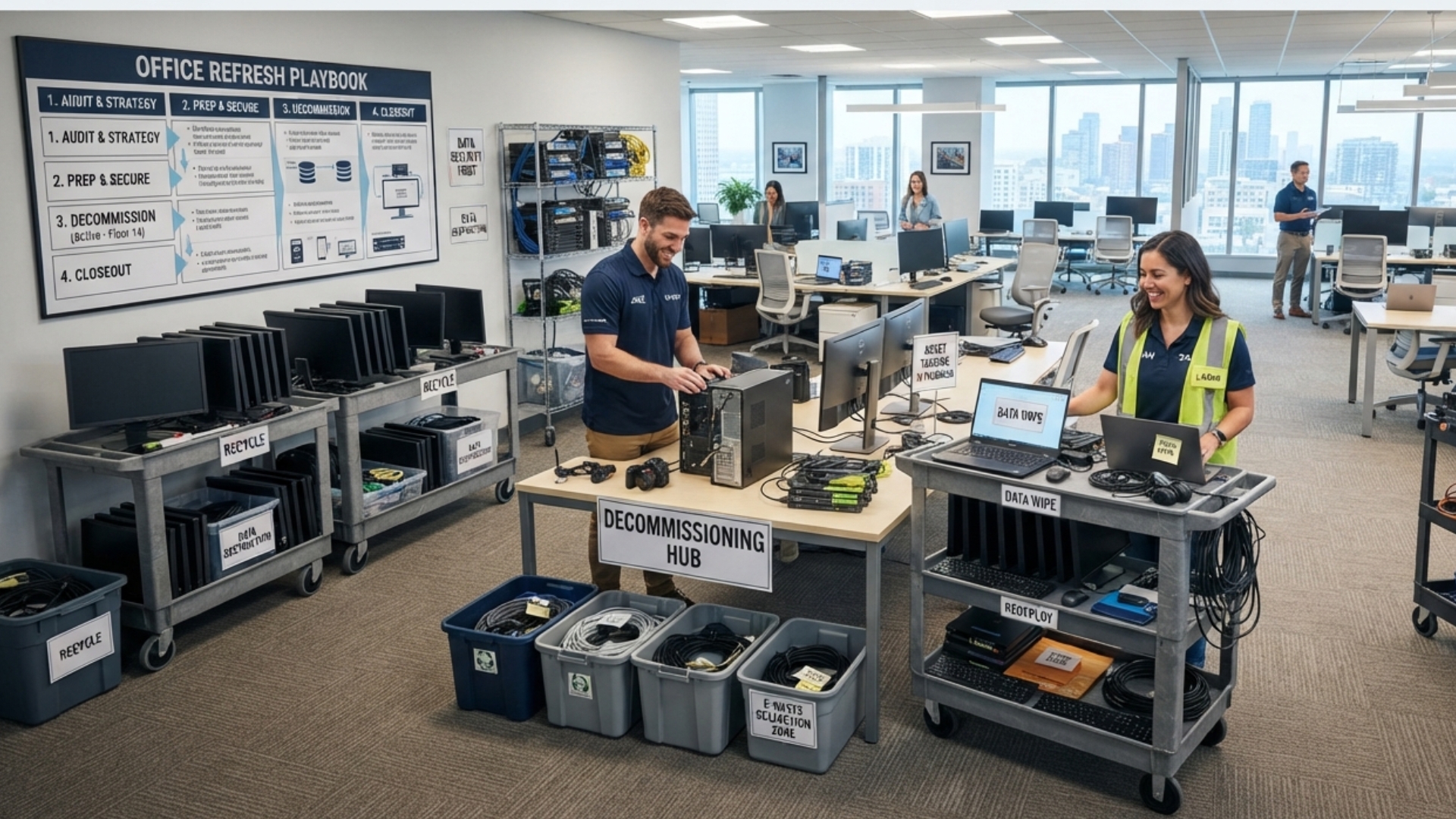
Office moves and IT refreshes have a way of going beautifully right up until the last week, when someone opens the comms room, the storage cupboards, and the under-desk kingdom of forgotten hardware, and discovers the project has a second project inside it: a small mountain of electricals with nowhere to go and a handover date that will not move.
What happens next, in the unplanned version, is expensive improvisation: skips that cannot legally take the monitors, a van man who definitely will, drives leaving the building with their stories still on them, and a landlord’s dilapidations letter itemising whatever got left behind.
The planned version is calm, and it is genuinely not much work because almost all of it is sequencing. Here is the playbook we run with businesses clearing anything from a floor to a whole estate.
Step One: Walk The Building Like An Auditor
Weeks before anything moves, someone walks every room with a spreadsheet and the post-it rule from our WEEE basics guide: if it uses power, it is in scope.
The walk always finds more than the asset register admits. Desks and the comms racks, yes, but also: the monitor stack in the stationery room, printers and their toner hinterland, desk phones from a system replaced in 2019, the kitchen’s kettles and microwaves and the fridge nobody defrosted, fans, heaters, chargers, the cable drawer that has achieved geological layering, UPS units and their heavy little batteries, projector lamps, tube lighting if the fit-out is coming down, and the till or card machines in customer-facing sites.
Three columns matter for each line: reusable or scrap (a rough grading is fine; recent laptops one way, dead CRTs the other), data-bearing or not (drives, phones, tablets, copiers with storage, USB sticks, and note our data destruction guide’s warning about the media hiding in printers), and rough quantity. This hour of walking is what turns the clearance from a guess into a quote, and it is exactly what a free assessment does with you if you would rather have company.
Step Two: Split The Three Lanes Early
Every clearance sorts, eventually, into three lanes. Sorting them early is the whole trick.
The value lane. Recently, working kit routes to IT asset management, where refurbishment and resale can make the project cost neutral or better, as our asset value guide explains. This lane pays for the others, so protect it: no cannibalising chargers from the good laptops, no stacking monitors screen-down under printer parts.
The data lane. Every drive and data device, regardless of which lane its host machine occupies, is pulled for physical shredding with certificates. This lane has the shortest tolerance for improvisation: media in secure containment, tracked from room to shredder, serials recorded where the estate warrants it. The office move is precisely when drives go missing, because everything is in boxes and everyone is busy; the lane exists so that it cannot happen quietly.
The recycling lane. Everything else: end-of-life machines, the cable strata, kitchen electricals, lamps and tubes in their proper boxes, batteries in theirs, the fridge awaiting its gas-safe recovery. Compliantly collected, materially recovered, documented.
Step Three: Stage With Real Containers, Not Corners
The improvised clearance stages equipment in heaps by the goods lift, where it grows, migrates, and sheds components. The planned one uses containment sized to the job, delivered ahead of need: cages, pallets, and stillages for mixed equipment, dedicated boxes for lamps, tubes, and batteries, whose breakage and fire risks earn them privacy, secure media containment for the data lane, and for the big or phased jobs, lockable enclosures up to 40-foot containers, marked out for segregation, which is exactly how we set up long-running clearances for retail and multi-floor clients.
Staging discipline does three quiet jobs: it keeps the value lane sellable, it keeps the fire marshal and the moving crews out of each other’s tempers, and it means collection day is a load-out, not an archaeology dig.
Step Four: Sequence The Collections Against The Move Plan
Now the calendar works. Standard collections book within 5 to 7 working days and land on a confirmed date; next-day exists for genuine emergencies; phased clearances schedule container by container as floors empty. The sequencing rules that save projects:
- Data lane travels first, early in the plan, so certificates exist before the chaos peaks and nothing sensitive sits in a half-empty building.
- Value lane goes while the building still has staff, because a reusable kit staged too long in an emptying office has a way of walking.
- Recycling lane sweeps last, after the final desk-clear, catching everything the move itself sheds.
- Nothing stays past handover. Abandoned electricals return as dilapidation charges and traceable waste liability, the vacated-unit fridge being the classic and least fragrant example; our decontamination and fridge guide has that story.
One provider across all lanes, one contact, tracked vehicles, and one reconciled paper bundle at the end: transfer documentation, destruction certificates, asset and rebate reports, matched against the step-one spreadsheet. File it, and the second project inside your project closes without a loose end.
Frequently Asked Questions About Office IT Clearances
How do we dispose of IT during an office move?
Inventory early, split value, data, and recycling lanes, stage in proper containers, and sequence collections against the move plan: data first, sweep last.
Who is liable for electricals left in a vacated office?
You. Landlords charge for removal, and waste is traceable to its producer. Clear and document before handover.
What containers are available?
Cages, pallets, stillages, lamp and battery boxes, secure media containment, and lockable enclosures up to 40-foot containers, UN-approved and delivered to site.
How fast can collections happen?
Confirmed dates within 5 to 7 working days as standard, next day for deadline trouble, phased schedules for big clearances, mainland UK to Glasgow and Edinburgh.
What paperwork results?
Transfer documentation, data destruction certificates, and asset reports, reconciled to your inventory. One folder, audit closed.
Can the clearance pay for itself?
Frequently, the reusable lane’s resale value offsets or exceeds the recycling lane’s costs, exactly as in standing IT asset management.
Move The Office, Not The Problem
Every office clearance ends one of two ways: a reconciled folder and possibly a rebate, or a mystery pallet in a new building’s storeroom and a drive nobody can account for. The difference is a spreadsheet, three lanes, and booking the calendar before it books you.
Priority WEEE runs clearances from single floors to national estates: containers supplied, data shredded and certificated, value recovered, and every load documented, on tracked vehicles, to confirmed dates. Call 0800 078 9580 or request a free review at priorityweee.co.uk, and give the second project a project manager.
