
A standard 5ft fluorescent tube contains a few milligrams of mercury. Not much, on its own.
A warehouse relamp takes out four hundred of them in an afternoon. Break those into a skip, and you have created a hazardous waste incident, contaminated an entire load, and left a paper trail that leads directly back to your business.
Lighting is the waste stream most businesses handle worst, largely because it does not feel like waste at all. It feels like maintenance.
Why lamps are classified as hazardous
Fluorescent tubes and compact fluorescent lamps work by passing current through mercury vapour. The mercury is essential to how the lamp produces light, and it is still in there when the lamp dies.
Mercury is a persistent toxin. It does not break down; it accumulates, and it moves easily through air and water once released. A tube that breaks in a skip releases vapour immediately, and the phosphor powder coating the inside of the glass carries the rest.
That is why waste lamps carry a hazardous EWC code, 20 01 21\*, and the asterisk matters. It means the material is hazardous, which brings consignment notes, licensed carriers and three-year record retention rather than two.
What counts, and what does not
Not all lighting is hazardous, and treating it as though it is wastes money.
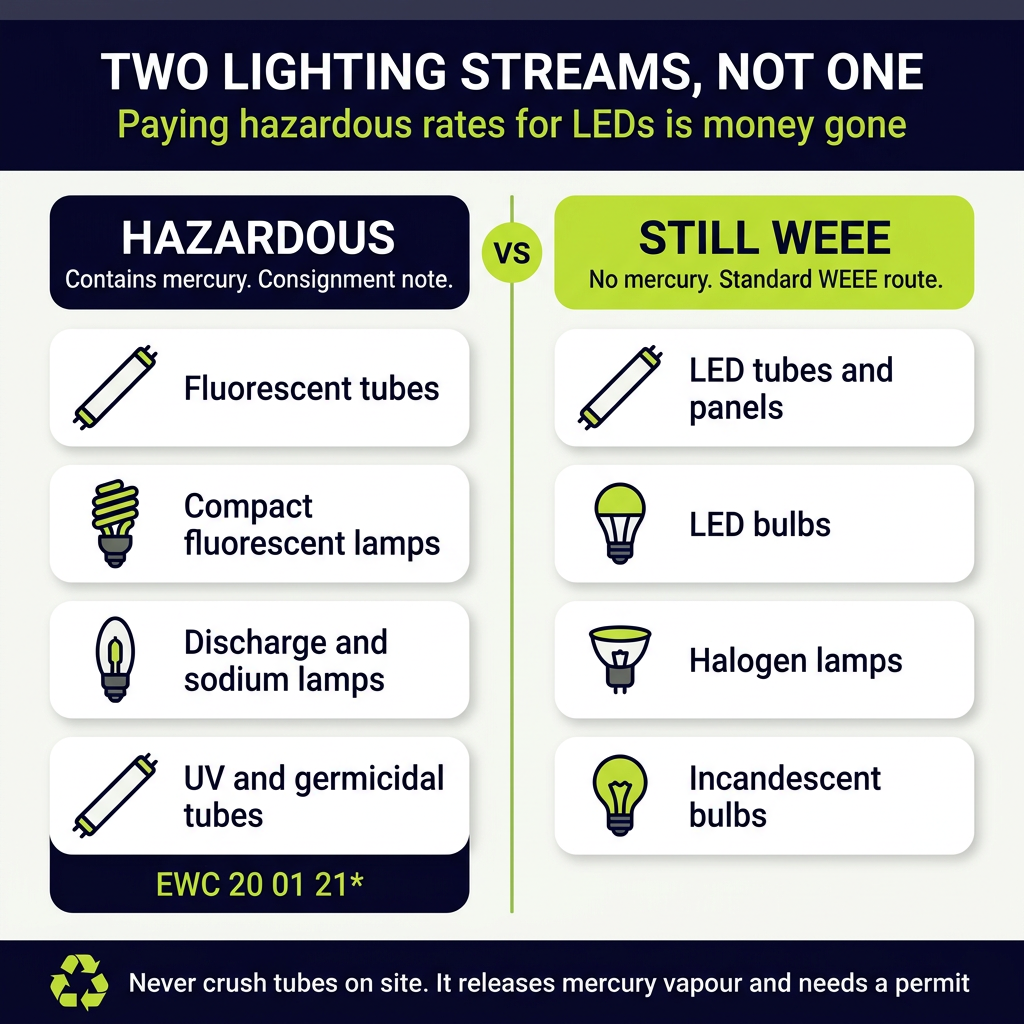
Hazardous, contains mercury:
- Linear fluorescent tubes, the standard office and warehouse strip light
- Compact fluorescent lamps, the older energy-saving bulbs
- High intensity discharge lamps, common in car parks, sports halls and industrial units
- Sodium lamps, the orange street lighting type
- UV and germicidal tubes
Not hazardous, but still WEEE:
- LED tubes and LED panels
- LED bulbs and fittings
- Halogen lamps
- Incandescent bulbs
LEDs are the point of confusion. They contain no mercury, so they are not hazardous. But they contain electronic driver circuitry, which makes them waste electrical equipment. They cannot go in general waste either. They simply follow a different, cheaper route.
If your site has been part-converted to LED, you now have two lighting waste streams, not one. Most sites in this position are paying hazardous rates for the lot.
Storage is where it goes wrong
Lamps are fragile, long, awkward and easy to stack badly. Almost every mercury release happens in the bin store, not at the treatment facility.
Use purpose-made lamp containment. Tube coffins for linear tubes, lidded drums for compact lamps. Cardboard boxes and open cages do not qualify.
Store them upright or flat and fully supported. Tubes leaned against a wall get knocked over. That is the single most common cause of breakage on a commercial site.
Keep containers closed. Mercury vapour escapes from broken lamps continuously. An open drum in a small storeroom is an occupational exposure issue, not just a waste one.
Keep them indoors and dry. Weather degrades containment and washes phosphor into drainage.
Label the container with the waste type and your business details, and keep hazardous and non-hazardous lighting apart.
Never crush or compact tubes on site. Some businesses buy tube crushers to save space. Crushing releases mercury vapour and requires an environmental permit. Unless you hold one, do not do it.
What to do if a tube breaks
It will happen. Have an answer ready before it does.
- Clear the area and ventilate it. Open windows, get people out, leave it for fifteen minutes.
- Do not vacuum. A vacuum cleaner aerosolises mercury and spreads it through the building on the exhaust.
- Do not sweep with a brush. Brushes drive the phosphor powder into floor surfaces.
- Collect the glass with stiff card, and pick up residue with sticky tape.
- Seal everything in a sealable container, including the tape and card, and label it as hazardous waste.
- Ventilate the area for several hours afterwards.
- Record it. Broken lamps still need to leave the site through the hazardous route.
Anyone who handles lamps should know these seven steps. It takes five minutes to brief, and it prevents the expensive version of this problem.
The relamp project nobody plans for
Most lighting waste arrives in a single spike. A site converts to LED, and four hundred tubes come out of the ceiling in two days.
Plan the waste before the contractor starts, not after:
- Count the fittings and order containment to match, before day one
- Confirm who removes the old lamps. Many electrical contractors will remove and leave. Removal is not disposal, and the waste stays yours.
- Book the hazardous collection to coincide with the works, so tubes are not sitting in a corridor for three weeks
- Split the streams at source. Old fluorescent tubes into hazardous containment, packaging into cardboard recycling, old fittings and any LED units into WEEE
- Check the fittings for capacitors. Older luminaires can contain PCB capacitors, which are separately hazardous and easy to miss
The fittings themselves are the forgotten item. A metal luminaire is scrap metal with an electrical component in it, which means recoverable value if it is separated and a WEEE breach if it goes in the skip.
Frequently asked questions
Can businesses put fluorescent tubes in general waste?
No. Fluorescent tubes contain mercury and are classified as hazardous waste under EWC code 20 01 21\*. They must be stored in suitable containment, collected by a licensed carrier and moved under a hazardous waste consignment note. Putting them in a general skip breaches your duty of care and risks a mercury release.
Are LED tubes hazardous waste?
No. LEDs contain no mercury, so they are not hazardous. They do contain electronic driver circuitry, which makes them waste electrical and electronic equipment, so they still cannot go in general waste. They follow the standard WEEE route, which costs less than the hazardous lamp route. Keep the two streams separate so you are not paying hazardous rates for LEDs.
How should waste lamps be stored before collection?
In purpose-made containment, tube coffins for linear tubes and lidded drums for compact lamps, kept closed, indoors, dry and either upright or flat and fully supported. Label the container with the waste type and your business details. Never crush or compact tubes on site, as that releases mercury vapour and requires an environmental permit.
What do I do if a fluorescent tube breaks at work?
Clear and ventilate the area for fifteen minutes. Do not vacuum and do not sweep, as both spread the mercury. Collect the glass using stiff card and lift residue with sticky tape, then seal everything, including the card and tape, into a labelled hazardous waste container. Ventilate for several hours afterwards and record the incident.
How long do I keep the paperwork for lamp disposal?
Hazardous waste consignment notes must be kept for at least three years, longer than the two years required for standard waste transfer notes. Keep them somewhere retrievable, because requests usually come at short notice from a regulator or a client running a supply chain audit.
The bottom line
Lighting waste is easy to get right and expensive to get wrong, and the difference is almost entirely about storage.
Get the right containers, keep the LEDs separate from the fluorescents, brief your team on the breakage procedure, and plan the containment before a relamp starts rather than after.
Priority WEEE collects fluorescent tubes, discharge lamps and LED lighting from businesses nationally, with the right containment supplied and full hazardous consignment documentation. Book a free waste review, and we will size the containment for your site before your next relamp.
