
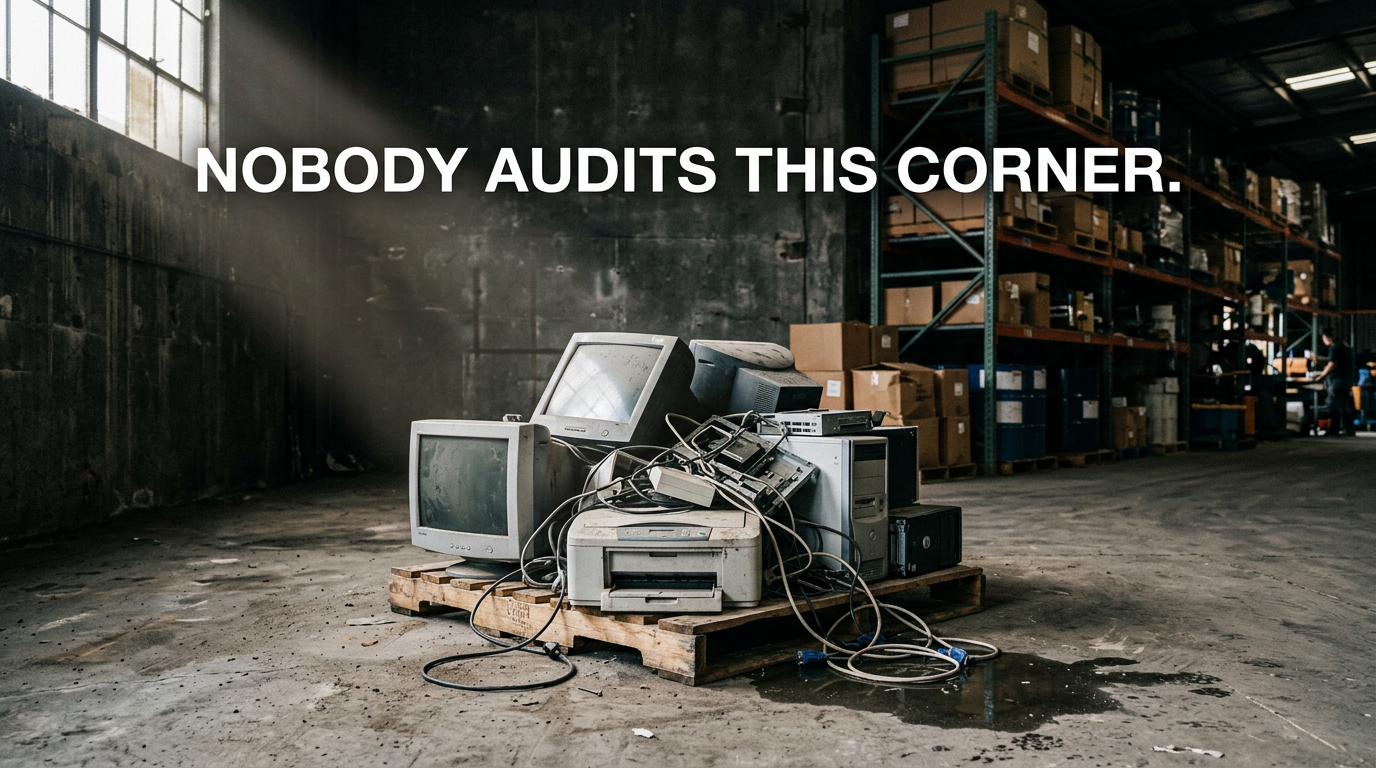
Every site has one. A corner behind the racking where the dead monitors go. A pallet by the fire exit stacked with old printers. A cage in the yard that has been rained on since March.
Nobody decided to create it. It accumulated, one broken item at a time, and it is almost certainly the weakest point in your waste compliance.
Storage is the stage nobody audits, because it happens between two things that do get audited: the moment equipment stops working, and the moment a lorry takes it away.
Storing waste is a regulated activity
There is a common assumption that duty of care starts when the waste leaves site. It does not. It starts the moment the material becomes waste, which is the moment you decide the item is finished.
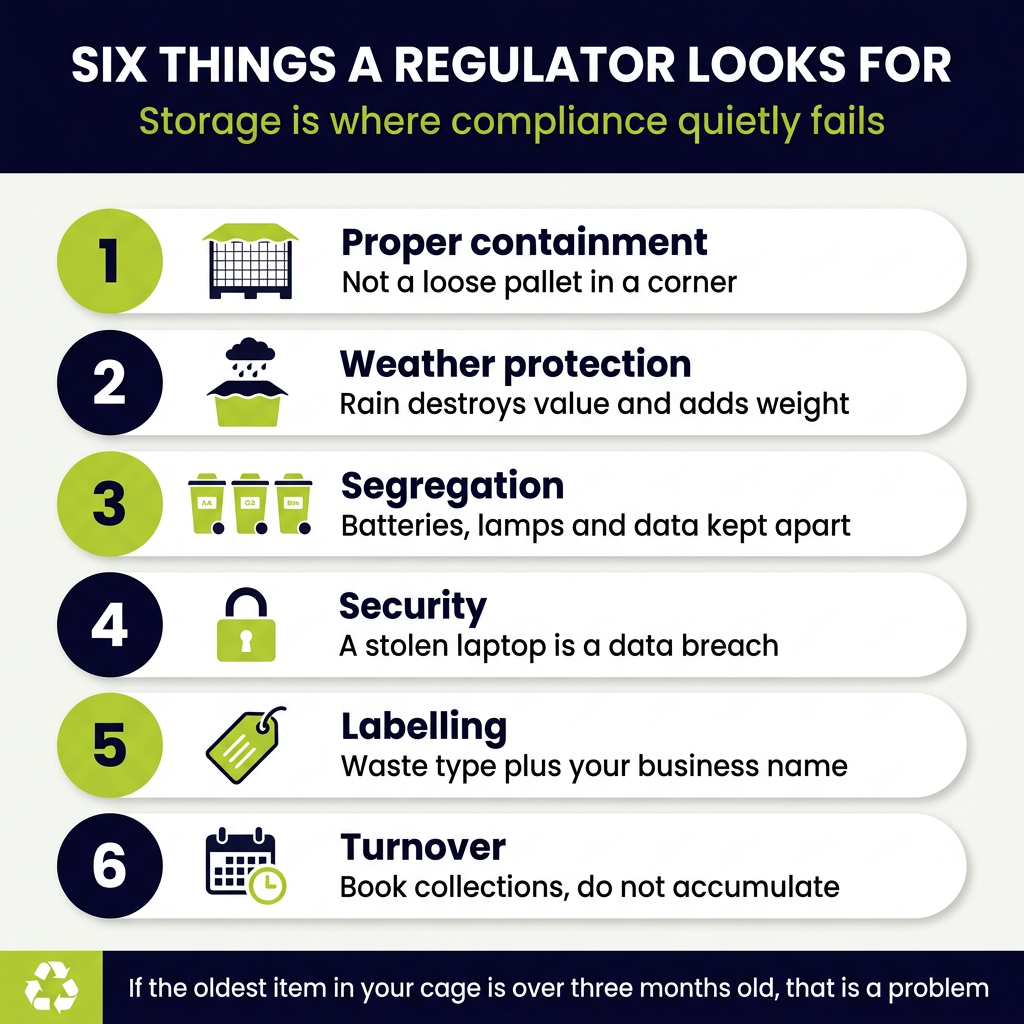
From that point you are holding waste, and you are responsible for holding it safely and securely. In practice, the environmental regulator expects stored waste to be contained, protected from the weather, segregated by type, secure against theft and scavenging, and not accumulating indefinitely.
Most businesses meet none of those five on their WEEE pile.
What good containment actually looks like
The right container depends on the stream, and using one container for everything is where most sites go wrong.
Stillages and cages suit mixed WEEE, IT equipment and small electricals. Look for solid sides rather than open mesh, because mesh lets small items fall out and lets rain in from the side. A lid or a cover matters more than people expect.
Wheeled containers with lids suit small electricals and steady low-volume production, and they work well positioned where the waste is actually generated.
Tube coffins and lidded drums are the only acceptable containment for fluorescent tubes and lamps. Cardboard boxes do not qualify.
Fire-retardant battery containers for anything with a cell in it. This is the one item where the container choice is a fire safety decision, not a tidiness decision.
Lockable, solid-sided containers or a lockable room for anything data-bearing. Laptops, drives, phones and copiers should never sit in an open cage.
Upright, undamaged storage for screens and cooling equipment. A cracked screen or a punctured fridge circuit turns ordinary WEEE into hazardous waste and contaminates whatever it is stored with.
The five things a regulator looks for
Weather protection. Rain does three things to stored WEEE. It corrodes and destroys resale value, it increases weight and therefore cost, and it carries contaminants into surface drainage. Outdoor storage without a cover is the most common finding on any site walk.
Segregation. Hazardous away from non-hazardous. Batteries away from everything. Data-bearing away from general. Lamps in their own containment. Mixing streams means the whole container gets treated as its most hazardous component, which is both a compliance risk and a cost.
Security. WEEE has value, which makes it a theft target. A stolen laptop from an unsecured cage is a data breach, and the ICO will ask how it was stored.
Labelling. Every container should carry the waste type and your business details. Unlabelled containers get refused at collection.
Turnover. Waste accumulating for months starts to look like unpermitted waste storage rather than temporary holding. If your cage has items in it from last year, that is a problem in its own right.
Where to put it, which matters more than people think
Placement decides whether the system works. Four rules:
Put containers where the waste is created. A container in the yard means equipment sits on desks and in cupboards until somebody makes a trip. A container on the floor where kit fails gets used immediately.
Do not block fire exits, escape routes or sprinkler coverage. Waste stored in a corridor is a fire risk and a fire regulations breach, and stacked WEEE against a wall is exactly what accumulates in corridors.
Keep it away from drainage. Anything with oil, refrigerant or phosphor in it near a surface water drain is a pollution incident waiting for heavy rain.
Make sure a lorry can reach it. Sounds obvious. A cage in the far corner of a yard with a low canopy over the access route means a manual carry, which means a higher collection charge and a slower service.
Fire risk deserves its own paragraph
Stored WEEE is a fire load, and it contains its own ignition sources.
Anything with a lithium cell in it can enter thermal runaway if damaged, and stored equipment gets stacked, dropped and crushed. A pallet of old laptops is a pallet of batteries.
Three practical controls:
- Pull batteries out where you safely can, particularly from power tools and UPS units, and store them in fire-retardant containment separately
- Never stack heavy items on top of battery-containing equipment
- Keep the WEEE store away from the building fabric where the site layout allows, and check it is covered by detection
Ask your insurer whether they have a view. Many now do, and finding out during a claim is the wrong moment.
A ten-minute audit you can run today
Walk to your WEEE storage point and answer these:
- Is everything inside a proper container, or is some of it just stacked?
- Is it protected from rain?
- Are batteries separated into fire-retardant containment?
- Are lamps in proper tube containment?
- Is data-bearing equipment locked?
- Are the containers labelled with waste type and your business name?
- Are any screens cracked or cooling units damaged?
- Is the oldest item less than three months old?
- Is it blocking an exit route or near a drain?
- Can a collection vehicle physically get to it?
Anything you answer “no” to is fixable this month, and most of it is fixable this week with the right containers.
Frequently asked questions
Do I need a permit to store waste electrical equipment on my own site?
Storing your own waste temporarily before collection generally falls under a waste exemption rather than a full permit, but exemptions carry conditions on quantity, duration and how the waste is held. Indefinite accumulation, or storing waste that did not originate on your site, can take you outside the exemption. If your WEEE pile has been growing for more than a few months, check your position with your provider.
How long can a business store WEEE before collection?
Temporary storage pending collection is expected to be exactly that. There is no single universal figure, so treat three months as a sensible working ceiling and book collections against volume rather than waiting until the cage overflows. Long accumulation attracts regulator attention and increases fire and theft risk.
Can WEEE be stored outside?
Only if it is properly contained and protected from the weather. Rain corrodes equipment, destroys any resale value, adds weight to your disposal cost and can carry contaminants into surface water drainage. If you must store outside, use covered, solid-sided containment positioned away from drains.
How should data-bearing equipment be stored before collection?
In lockable, solid-sided containment or a lockable room, separated from general WEEE, with a record of what went in. An unsecured cage of old laptops is a data breach waiting to happen, and under UK GDPR you remain the data controller until the drives are verifiably destroyed.
What containers do I need for business electrical waste?
At minimum, a stillage or covered cage for mixed WEEE and IT, tube coffins or lidded drums for fluorescent lamps, a fire-retardant container for batteries, and something lockable for data-bearing items. A good provider supplies the containment as part of the service rather than leaving you to source it.
The bottom line
Nobody fails an audit because of the lorry. They fail because of the corner behind the racking.
Get the right containers, keep them covered, split the batteries and the data out, and set a collection frequency that stops the pile growing. That is the whole job, and it takes an afternoon to put right.
Priority WEEE supplies the containment as part of the collection service, sized to your site and split by stream, with scheduled collections so nothing accumulates. Book a free waste review, and we will walk your storage point with you.
