
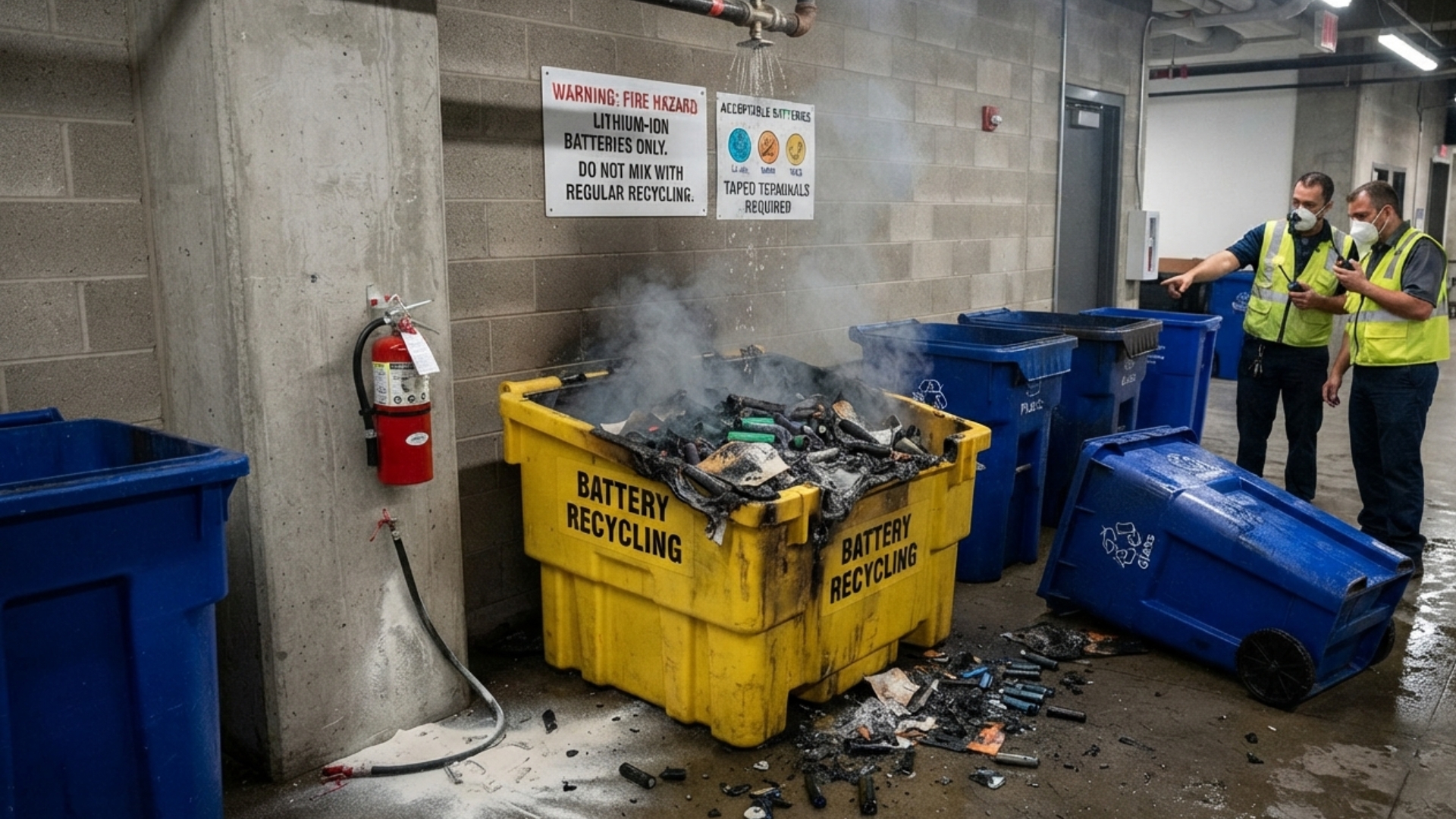
Somewhere in Britain today, a bin lorry will catch fire. Not because of anything dramatic in the load, but because of something tiny: a lithium battery, tossed into general waste inside a dead gadget, crushed by the compactor, shorting into thermal runaway among the paper and plastic it was riding with.
The waste industry now logs these fires by the hundred every year, in lorries, transfer stations, and recycling plants, and insurers, regulators, and fire services all point at the same culprit: batteries where batteries should never be. What used to be a modest compliance line, keep batteries out of the bin, has become one of the most practical fire-safety rules a business can enforce.
Here is why the smallest waste stream in your building deserves its own container, and how workplace battery collections make the whole problem disappear.
Why A Battery Is Not Ordinary Rubbish
Every battery is a small package of stored chemical energy, and it does not stop being one when the device around it dies.
Lithium cells are the headline risk. Phones, laptops, power tools, e-bikes, vapes, cordless everything: their energy density is the point, and their failure mode is the price. Puncture, crush, or short a lithium cell- exactly what compactors and bin lorries do for a living- and it can enter thermal runaway: a self-feeding chemical fire that burns ferociously, resists dousing, and relights after everyone has relaxed. A single vape battery has closed entire recycling facilities.
The older chemistries bring poisons instead. Lead-acid from UPS units and emergency lighting, nickel-cadmium from older tools, mercury traces in some button cells: heavy metals with no business in landfill leachate or incinerator ash.
And all of them carry value. Steel, zinc, manganese, and increasingly precious cobalt, nickel, lithium, and copper, the exact metals the electrified economy is scrambling for, sit in every cell, recoverable by recycling and lost by binning. The same urban-mining logic our what-is-inside-your-electronics guide describes applies here in concentrated form.
The law reads accordingly: batteries are banned from general waste and travel as their own collected stream. But honestly, the fire statistics make the case before the regulations get a word in.
The Audit: Where Batteries Hide In Your Business
Ask a business how many batteries it disposes of and the answer is usually “a few AAs”. Walk the building, and the truth emerges.
The IT estate: laptop batteries, phone and tablet cells, the UPS bank under the server rack with its heavy lead-acid trays. Facilities: emergency lighting packs on every escape route, tested and swapped on schedule, cordless tool packs in maintenance, door access and alarm backups. The office floor: keyboards, mice, headsets, remotes, clocks, the drawer of mystery cells beside the stationery. Front of house and welfare: the vape amnesty jar, toys in the waiting area, promotional gadgets. And inside every dead device destined for WEEE collection, another battery, which is why battery segregation and electrical clearances, like the ones in our office refresh playbook, travel together.
The pattern is universal: batteries arrive item by item, everywhere, constantly, and with no designated home, they migrate to the nearest bin. The fix is the same shape as the problem: a designated home.
The Container Habit That Solves It
Workplace battery compliance is one container and three habits.
- A dedicated battery box, visibly placed. Purpose-made containers, supplied as part of the collection service, live where batteries actually die: by IT, in the staff room, at the maintenance bench. Multi-site businesses run one per site. The moment a box exists, the general bin stops receiving batteries, because convenience finally points the right way.
- Tape the lithium terminals, quarantine the wounded. Loose lithium cells with exposed terminals should have them taped where practical, and any swollen, damaged, or leaking battery goes into individual non-flammable containment; a sand bucket or ceramic pot serves, away from the healthy stock, flagged for priority collection. A swollen battery is not a curiosity; it is a countdown.
- Store cool, dry, and modestly. Away from radiators, sunlight, and sprinklered-over-paper storage, and collected before the box becomes an archive. Little and often beats a decade’s hoard, for batteries more than any stream we handle.
Collections then run to fit the producer: scheduled exchanges for the steady accumulators, on-call pickups for the occasional, and large-scale regular arrangements for retailers, schools, and estates, UK-wide from our Bedford base, Glasgow and Edinburgh included, on confirmed dates, typically inside 5 to 7 working days. Every collection is documented into the same compliance file as the rest of your WEEE paperwork.
Where The Cells Go Next
Collected batteries are sorted by chemistry and head into genuinely satisfying recovery chains.
Alkaline cells surrender steel, zinc, and manganese. Lead-acid recycling is one of the oldest closed loops in industry, with its lead returning almost entirely to new batteries. And the lithium family, the growth stream, gives up cobalt, nickel, lithium, and copper to increasingly sophisticated recovery processes feeding the battery supply chain itself: yesterday’s laptop pack contributing to tomorrow’s cell, which is the circular economy actually circulating.
None of that happens to the battery that burned a lorry to the axles on a Tuesday. The container habit is the whole difference.
Frequently Asked Questions About Business Battery Recycling
Can businesses put batteries in general waste?
No, legally, and emphatically not practically: crushed lithium cells are a leading cause of waste fires. Dedicated collection is the only correct route.
Why do lithium batteries catch fire in waste?
Crushing and shorting trigger thermal runaway, a self-feeding fire that resists extinguishing and reignites. Compactors provide the trigger; hidden batteries provide the fuel.
How should we store used batteries?
Dedicated container, cool and dry, lithium terminals taped where practical, damaged or swollen cells quarantined individually and collected promptly.
What happens to recycled batteries?
Chemistry-sorted metal recovery: steel and zinc, closed-loop lead, and cobalt, nickel, lithium, and copper back into manufacturing, including new batteries.
What counts as a battery?
Everything: AAs to e-bike packs, UPS trays to vape cells, and the batteries inside every dead device heading for WEEE collection.
How do collections work?
Supplied containers, scheduled or on-call exchanges, from small boxes to large-scale regular pickups, UK-wide, documented, typically within 5 to 7 working days.
Give The Smallest Stream The Shortest Path
Every battery in your building will eventually be waste, and each one faces a fork: a supplied box, a documented collection, and a second life as recovered metal, or the general bin, a compactor, and a fire report. The container costs almost nothing. The alternative occasionally costs a building.
Priority WEEE runs battery collection and recycling at every scale, boxes supplied, chemistries handled, paperwork included, alongside every other electrical stream your business produces. Call 0800 078 9580 or request a free review at priorityweee.co.uk, and put the shortest path in place this week.
