
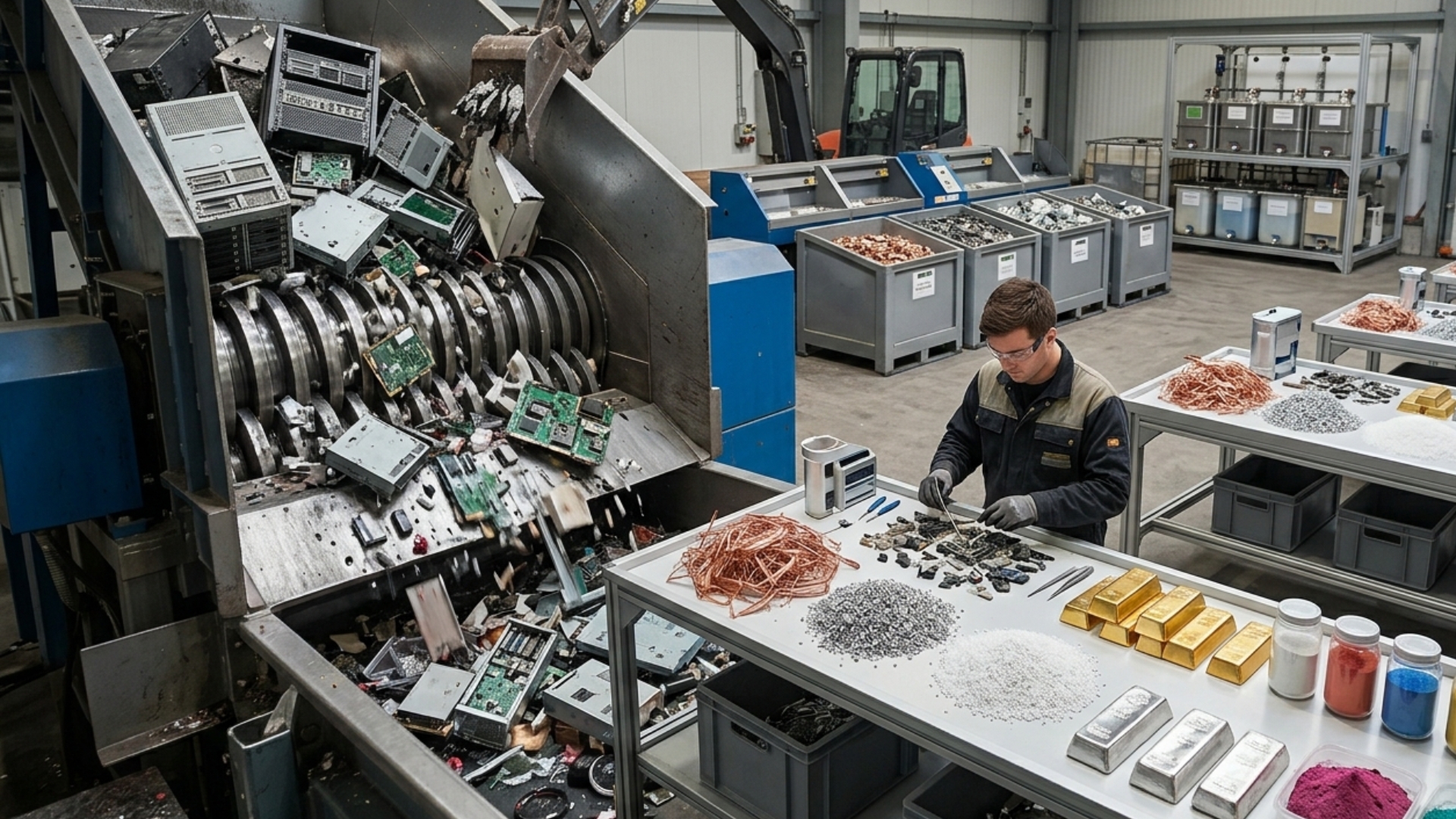
Pick up a dead hard drive, the sort your business has retired by the shelf-load, and you are holding a geology lesson. Aluminium casing. Copper windings. A circuit board freckled with gold-plated contacts. And inside, gripping the actuator arm, a magnet made with neodymium, a rare earth metal that modern industry cannot function without and that almost no country mines at scale.
Now multiply by everything your business has ever plugged in, and by every business, and the punchline writes itself: the richest metal deposits in Britain are not under the ground. They are in cupboards, server rooms, and storage units, waiting for someone to file the paperwork.
This is the case for taking e-waste recycling seriously as extraction rather than disposal, and a tour of what actually comes out when your old estate goes through the process.
The Inventory: What Your Old Kit Is Made Of
Electronics are dense sandwiches of the periodic table, and the recycling industry reads them like an assay report.
The bulk metals. Steel frames and cases, aluminium chassis and heatsinks: the tonnage layer, endlessly recyclable at a fraction of the energy of virgin production. Every desktop tower is mostly this.
Copper, everywhere. Wiring, motor windings, transformers, heatpipes, and the great cable mountain every office grows. Copper is the metal of electrification, demand is climbing relentlessly, and recycled copper is indistinguishable from mined.
The precious layer. Gold on connectors and contacts, because it never corrodes; silver in solders and switches; palladium in capacitors. Per device the quantities are grams and fractions, but concentration is the trick: a tonne of circuit boards carries many times more gold than a tonne of commercial gold ore, which is why board recycling is smelting’s favourite feedstock.
The strategic layer. Rare earths, neodymium foremost, in the magnets of every hard drive, speaker, and compact motor. Nothing about the drives your business retires is more geopolitically interesting than those magnets: supply is concentrated in a handful of countries, Western manufacturing is scrambling for alternatives, and recovery from e-waste is one of the few domestic sources that exists. When our IT recycling process shreds a drive, that shredded material goes back to market for smelting and reuse in manufacturing: steel, neodymium, copper and the rest, exactly as it should.
And the liabilities. The same devices carry the hazards, lithium batteries, mercury lamps, refrigerant gases, leaded glass, that make compliant processing non-negotiable, as our fridge and battery guides detail. The treasure and the toxins travel together, which is the entire argument for the formal route.
Urban Mining: Why The Economics Flipped
“Urban mining” sounds like consultancy poetry, but it describes something real: treating the existing stock of manufactured goods as the ore body.
The comparison with conventional mining is not close. Recovering metals from e-waste uses dramatically less energy than primary extraction, skips the open pit and the tailings dam entirely, and starts from concentrations, gold in boards, neodymium in magnets, copper in cable, that a mine geologist would celebrate. Recycled aluminium famously needs only a small fraction of the energy of smelting new; copper and steel tell similar stories.
Meanwhile the demand side has turned strategic. Electrification, renewables, and computing are all metal-hungry, and supply chains for the critical materials run through uncomfortably few countries. The UN’s Global E-waste Monitor counts the world’s e-waste above 60 million tonnes a year, the fastest-growing waste stream anywhere, while well under a quarter is formally collected and recycled. The rest, and its embedded metals, is lost to landfill, incineration, and informal processing that poisons the people doing it.
Which reframes the humble business clearance considerably: the pallet of dead towers leaving your loading dock, documented, is a small, real contribution to the only metal supply chain that runs through Britain’s storerooms.
From Loading Dock To Smelter: How The Process Runs
What actually happens after a collection is a sorting story in three acts.
Triage first, because the hierarchy pays: anything reusable is worth more whole than shredded, which is the entire premise of IT asset management, and batteries, lamps, and cooling equipment exit into their specialist streams before anything meets a shredder.
Then separation at industrial scale. Shredding, magnetic extraction of steel, eddy-current separation flinging aluminium one way and leaving copper another, density and optical sorting for plastics and boards. The engineering is genuinely elegant: a river of fragments un-mixing itself by physics.
Finally, refining. Circuit boards and precious-bearing fractions go to specialist smelters that recover gold, silver, palladium, and copper at purities the mint would accept; steel and aluminium re-enter their eternal loops; recovered plastics return where quality allows; and the magnet fractions feed the young but growing rare earth recovery chain.
Every stage is permitted, audited, and documented, which is what separates this route from the grim informal version, and what your waste paperwork actually certifies: not just that the pile left, but that it arrived somewhere that extracts value instead of exporting harm. The compliance file from our WEEE basics guide is, seen this way, a chain of custody for a mineral shipment.
What This Means For Your Next Clearance
Three practical takeaways fall out of the geology.
- Your e-waste has value, so expect it to be treated as valuable. Assessments that grade for reuse, pricing that reflects recoverable material, and free or revenue-positive collections where the kit justifies it, per the criteria in our asset management guide.
- Segregation multiplies recovery. Drives with drives, cable gathered, batteries boxed, lamps whole: the cleaner the streams leaving your site, the more the physics downstream can un-mix, and the better the numbers on both the environmental report and the quote.
- The documented route is the whole point. The informal collector breaks the chain precisely where the value and the hazards both live. Licensed collection, tracked vehicles, and paperwork, ours under CBDU292438, are what turn a cupboard of dead kit into recovered metal instead of somebody else’s pollution.
Frequently Asked Questions About E-Waste Materials
What is recovered from recycled electronics?
Steel, aluminium, copper, gold, silver, palladium, rare earths including neodymium, and recoverable plastics, separated by industrial sorting and refined back to manufacturing grade.
Is there really gold in old computers?
Yes, plating the connectors and contacts. Per tonne, circuit boards out-grade commercial gold ore comfortably, which is what makes recovery economic.
What is urban mining?
Extracting metals from existing products instead of the ground: lower energy, no pits, richer concentrations, and a domestic supply chain for scarce materials.
Why do rare earths matter?
Neodymium magnets drive hard drives, speakers, and motors, and supply is geographically concentrated. Shredded-drive recovery feeds them straight back to industry.
How much e-waste gets recycled?
Under a quarter, globally, per UN monitoring. The gap is the opportunity, and every documented collection narrows it.
How do we start?
A free assessment of your retired estate: reuse graded, streams planned, collection dated, paperwork guaranteed. Mainland UK, typically within 5 to 7 working days.
Send Your Ore To The Right Refinery
The server room cupboard was never a graveyard. It is a stockpile, and the only question is whether its metals re-enter the world through a documented recovery chain or leak out of an informal one.
Priority WEEE routes business e-waste into full material recovery, reuse first, shredding and smelting after, hazards contained throughout, with the paperwork to prove every tonne. Call 0800 078 9580 or request a free review at priorityweee.co.uk, and put your mine into production.
