
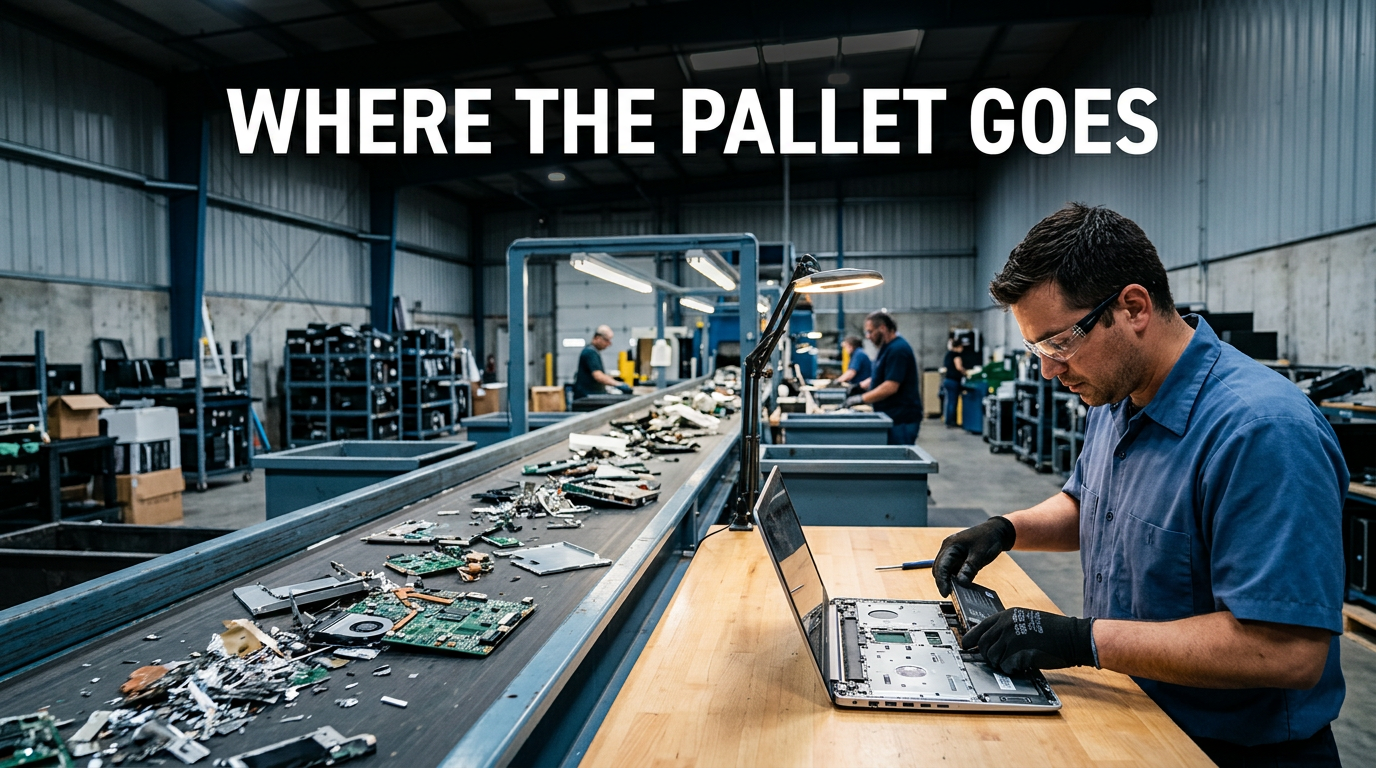
A pallet of dead laptops leaves your office on a Tuesday. Somebody signs a docket. The pallet disappears.
Most businesses never find out what happened next, which is a problem, because you remain legally responsible for that equipment long after it leaves your car park.
Here is what actually happens between the loading bay and the recovered material, and what you should be able to prove at each stage.
What WEEE recycling means
WEEE recycling is the controlled process of collecting end-of-life electrical equipment, removing the parts that are hazardous or valuable, and recovering the raw materials so they go back into manufacturing rather than into the ground.
It is not the same as throwing electricals in a recycling bin. It happens at a licensed site called an Approved Authorised Treatment Facility, or AATF, which is permitted by the environmental regulator to handle this material and to issue evidence that it did.
That permit is the thing that matters. Anyone can put a laptop in a lorry. Only an AATF can lawfully treat it and prove the outcome.
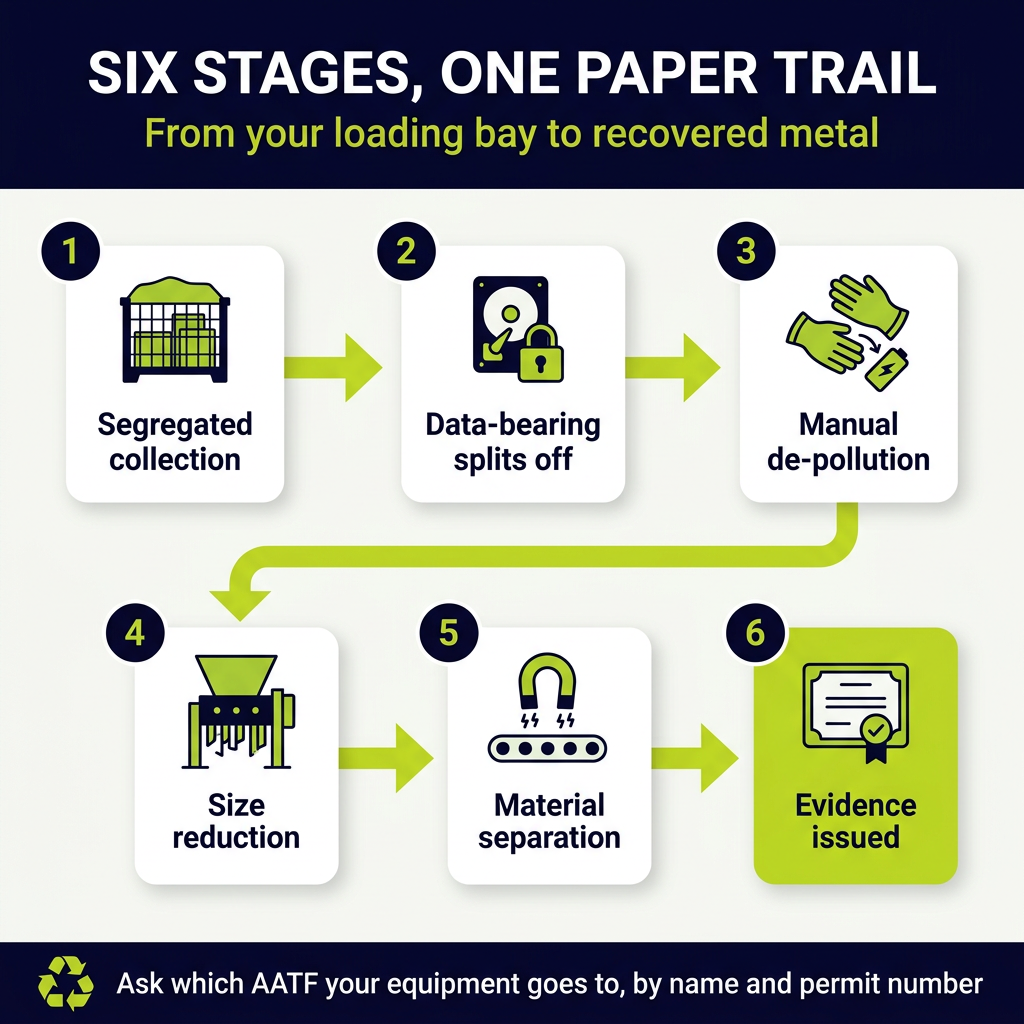
The six stages, start to finish
Stage one: segregated collection
Equipment is collected in dedicated containment rather than mixed with general waste. Screens and fridges travel upright and undamaged, because a cracked screen or a punctured cooling circuit releases exactly what the process is designed to capture.
A waste transfer note is raised at this point. Hazardous items get a consignment note instead.
Stage two: data-bearing equipment splits off
Anything with storage in it, meaning laptops, servers, phones, tablets, copiers and multifunction printers, leaves the general stream here.
This is the stage most businesses assume is happening and never verify. Recycling and data destruction are different jobs with different evidence.
Stage three: manual de-pollution
The regulated bit. Before anything is shredded, hazardous components are removed by hand:
- Batteries, which cause fires in shredders
- Fluorescent backlights and lamps, which contain mercury
- Circuit boards containing brominated flame retardants
- Capacitors that may contain PCBs
- Refrigerant gases and compressor oils in cooling equipment
- Toner and ink
Skip this stage, and you contaminate everything downstream. It is also the stage that separates a genuine AATF from a scrap merchant with a shredder.
Stage four: size reduction
What remains is shredded into fragments a few centimetres across, which exposes the different materials so they can be separated mechanically.
Stage five: separation
The fragments run through a sorting line:
- Magnets pull out steel and iron
- Eddy current separators throw out aluminium and copper
- Density and air classification separate light plastics from heavy metals
- Optical sorting splits plastics by polymer type
Stage six: recovery and evidence
Separated materials go to smelters and reprocessors. Steel, aluminium, copper, gold, palladium and plastics all re-enter manufacturing.
The AATF then issues evidence notes confirming the tonnage treated. That evidence is what proves the chain ended where it was supposed to.
What you should get back on paper
Ask for all of it. If a supplier hesitates on any item, that tells you something.
- Waste transfer notes for every non-hazardous collection
- Hazardous waste consignment notes for fridges, tubes, batteries and anything else classified as hazardous
- A certificate of destruction for data-bearing equipment, listing serial numbers
- Confirmation of the AATF used, by name and permit number
- Weights by stream, so you can see what actually went where
- Recovery and recycling rates, if you report on sustainability or hold ISO 14001
The serial number list is the one businesses most often accept without. A certificate that says “one pallet of IT equipment” proves nothing about any individual drive.
Why this matters commercially, not just legally
Your liability does not end at the gate. Duty of care under the Environmental Protection Act 1990 follows the waste. If equipment is fly-tipped three links down a chain you did not check, the investigation comes back to you.
Data breaches travel in hardware. A drive that leaves your building intact and unrecorded is a breach waiting to be discovered, and the ICO does not accept “we assumed the recycler wiped it”.
There is recoverable value in the pile. Working equipment that can be refurbished and resold is worth more than shredded material. A good provider tells you which of your kit falls into that bracket rather than shredding everything and keeping the difference.
Your customers increasingly ask. Supply chain and ESG questionnaires now routinely ask where electrical waste goes and what the recovery rate is. Without evidence notes you cannot answer.
Frequently asked questions
What is WEEE recycling?
WEEE recycling is the regulated treatment of end-of-life electrical and electronic equipment at an Approved Authorised Treatment Facility. Hazardous components such as batteries, mercury lamps and refrigerant gases are removed by hand first, then the remaining material is shredded and separated so metals and plastics can be recovered and returned to manufacturing.
What is an AATF?
An Approved Authorised Treatment Facility is a site permitted by the environmental regulator to treat WEEE and to issue evidence notes confirming the tonnage handled. Only an AATF can lawfully complete the treatment process and produce the evidence that closes your chain of custody. Ask any provider which AATF your equipment goes to, by name.
Does WEEE recycling include wiping the data?
No, not automatically. Recycling and data destruction are separate services with separate evidence. If your equipment holds data, you need a documented destruction process and a certificate of destruction listing serial numbers, on top of the WEEE treatment. Never assume one includes the other.
How much does business WEEE recycling cost?
It depends on volume, equipment type and how much hazardous content is involved. Fridges, air conditioning units and CRT screens cost more because de-pollution is labour intensive. IT equipment often costs less than expected, and equipment with resale value can offset the collection cost entirely. Some equipment may qualify for free take-back from the original supplier.
What paperwork proves my WEEE was recycled properly?
Waste transfer notes for non-hazardous loads, consignment notes for hazardous items, a certificate of destruction with serial numbers for data-bearing equipment, the name and permit number of the AATF used, and weights by stream. Keep transfer notes for two years and consignment notes for three.
The bottom line
You cannot manage what you cannot see, and most businesses cannot see past the loading bay.
Ask three questions of whoever collects your electricals: which AATF does it go to, what do I get in writing, and what happens to the drives. Any provider worth using answers all three without pausing.
Priority WEEE collects and treats business electrical equipment nationally through approved facilities, with certificates of destruction, evidence notes and weights reported by stream. Book a free waste review, and we will show you exactly where your equipment ends up.
