
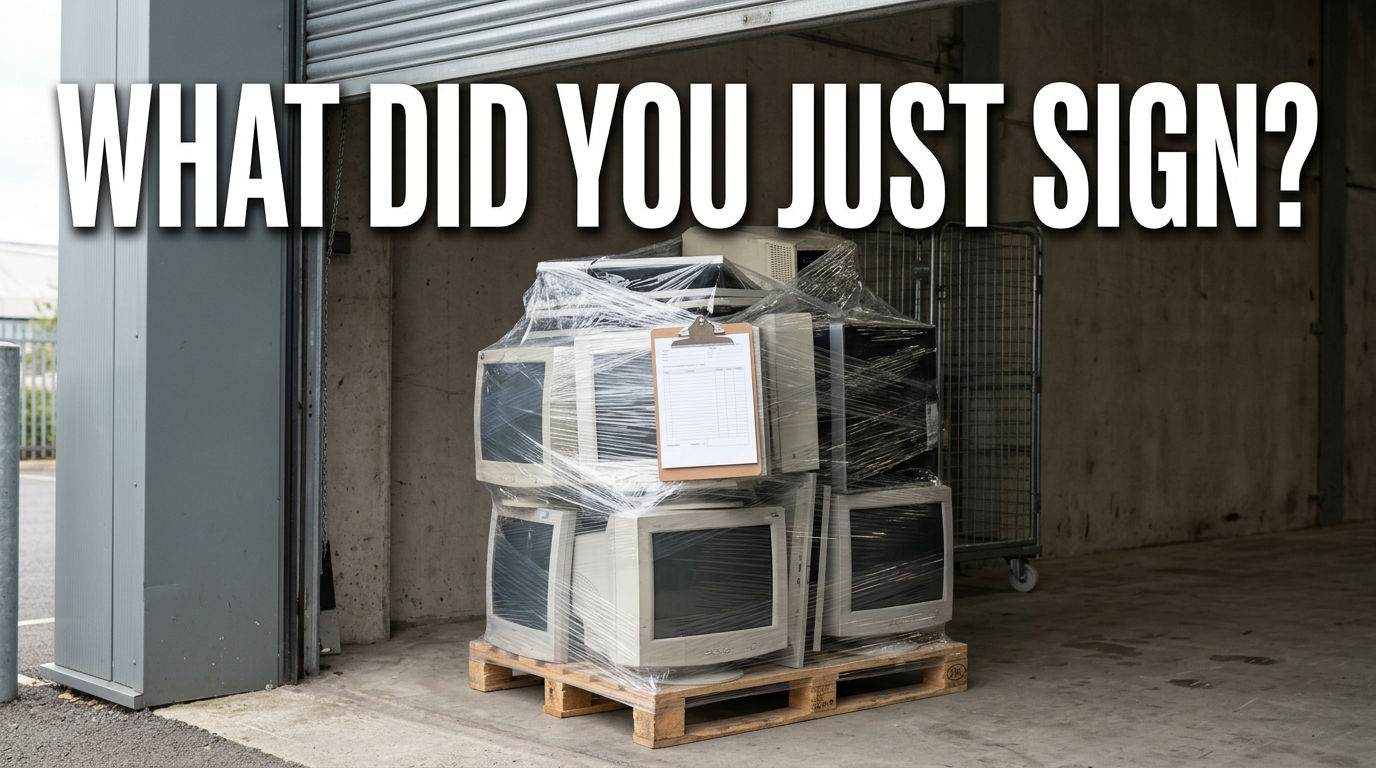
A pallet of old monitors sits by the loading bay, wrapped and ready to go.
The van arrives, the driver loads it and hands over a form. Somebody signs it without reading it.
That form is your legal record of where the waste went. If the code on it is wrong, the record is wrong too.
Why the paperwork matters
Every business that produces waste has a duty of care. In Great Britain, that duty sits in section 34 of the Environmental Protection Act 1990.
It means you must store waste safely and pass it only to someone authorised to take it. You must also describe it properly.
The description is the part most people skip. It tells the next person what they are handling, what risks it carries and how to treat it.
You stay responsible after the van leaves. If your waste turns up in the wrong place, the trail leads back to you.
Our guide to WEEE compliance in the UK covers the wider rules. This post focuses on the forms.
What an EWC code is
Every type of waste has a six-digit code from the List of Waste. Most people still call them EWC codes, after the older European Waste Catalogue.
The code tells everyone what the waste is and where it came from. It also shows whether the waste is hazardous.
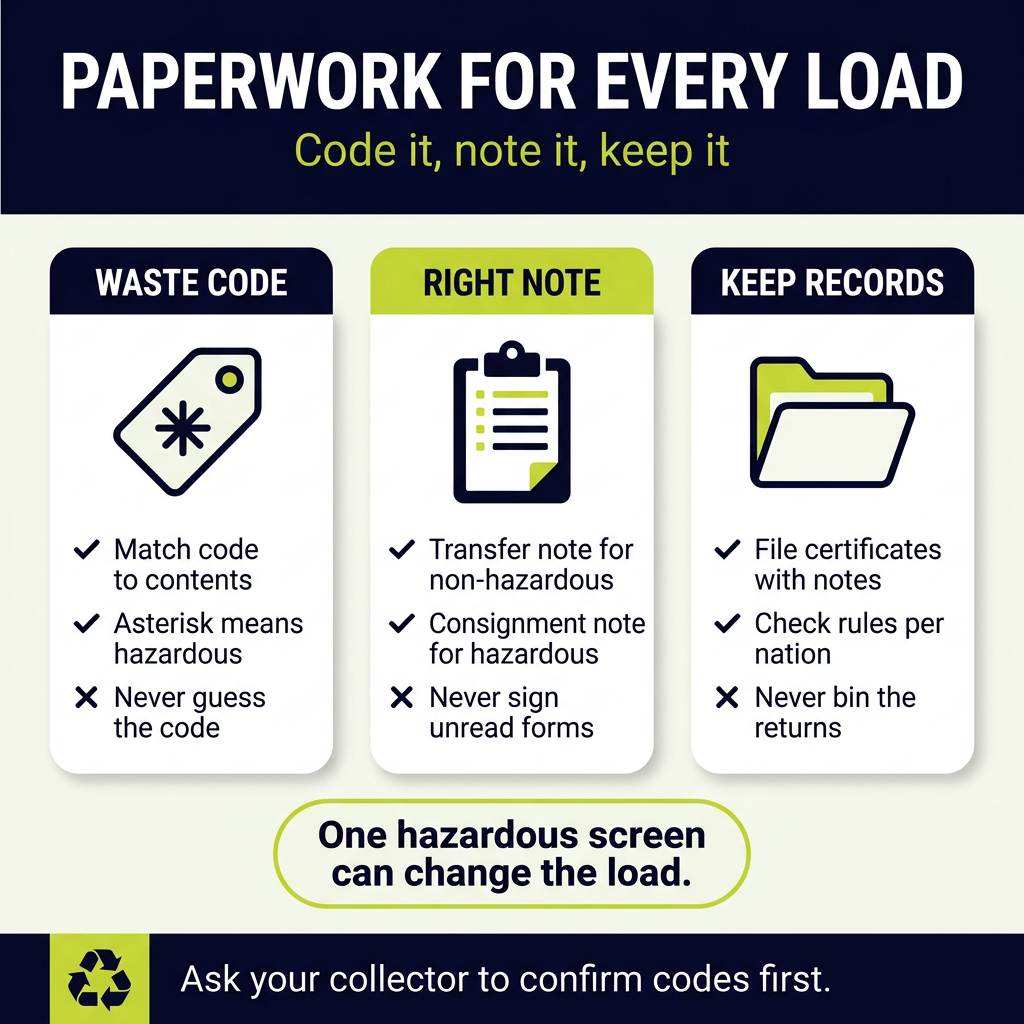
An asterisk marks a hazardous entry. A code with a star after it means the waste needs the stricter paperwork.
Many entries come in pairs, called mirror entries. One code covers the hazardous version, and its partner covers the rest.
Electrical waste is full of these pairs. The right one depends on what is inside the kit, not on what the kit looks like from the outside.
The WEEE waste codes you will see
Business electrical waste usually sits in chapter 16 or chapter 20 of the list.
Chapter 16 covers waste from industry and commerce. Chapter 20 covers municipal waste, including similar waste from offices and shops.
Here are the pairs that come up most often.
16 02 13 and 16 02 14.* The first covers discarded equipment with hazardous components. Its partner covers equipment without them.
20 01 35 and 20 01 36.* These are the municipal-type versions of the same split. Office kit often falls under these.
20 01 21.* This covers fluorescent tubes and other waste containing mercury. Our guide to lamp and fluorescent tube recycling explains how to store them.
16 02 11.* This covers equipment containing CFCs, HCFCs or HFCs. Fridges and some cooling units sit here, and our guide to fridge and freezer disposal explains why.
16 06 01.* This covers lead batteries, such as the ones inside a UPS cabinet.
So which code fits your monitors?
It depends on the screens, and on what sits inside each one. That is the honest answer.
Old CRT monitors contain leaded glass. Many older flat screens use backlights that contain mercury. Both usually count as hazardous.
Newer LED screens may contain neither, so they can often move under the non-hazardous code instead.
A mixed pallet is the tricky case. One hazardous screen hidden in the middle can change the code and the paperwork for the whole load.
Do not guess the code. Ask your collector to check the kit and confirm the code before collection. If you are still unsure, check with the Environment Agency or your local regulator.
Waste transfer notes for non-hazardous loads
Non-hazardous waste moves on a waste transfer note. It records what the waste is, how much there is and who takes it.
It also records the code, the date, the place of transfer and both parties’ details. Both sides sign it.
You must keep transfer notes for at least two years. Many businesses keep them longer to match their own audit cycle.
A single note can cover a regular service, such as a monthly collection of the same waste. Check that the description still fits each time, because the mix on a pallet can change each month.
Consignment notes for hazardous loads
Hazardous waste in England needs a hazardous waste consignment note. It goes with the load from your site to its destination.
The note carries more detail than a transfer note. It lists the codes, the hazards, the quantity, the packaging and the chemical makeup.
You, the carrier and the receiving site each complete a part of the note as the load moves along. The receiving site then sends a return confirming it took the load.
Keep consignment notes for three years in England. File the return with your copy, so you can show where the waste ended up.
If a load mixes hazardous and non-hazardous items, the hazardous part needs the consignment note. Many collectors separate the two at your site.
Scotland, Wales and Northern Ireland
The rules above describe England. The other nations run their own systems.
Scotland treats hazardous waste as special waste, regulated by SEPA. Wales has its own hazardous waste rules, regulated by Natural Resources Wales.
Northern Ireland has its own system too, run by the Northern Ireland Environment Agency, with its own hazardous waste forms.
The principles are similar, but the forms, codes of practice and fees differ. If you have sites in more than one nation, check each one locally.
Digital waste tracking is coming
The UK governments plan to move waste records onto a single digital tracking service. Paper notes and scattered spreadsheets will give way to one shared system.
The aim is to follow waste from the producer all the way to final treatment. It should also make illegal dumping and false descriptions harder to hide.
The details and timing are still settling, so watch for guidance from your regulator. Clean, accurate codes now will make the switch much easier.
Keep the certificates with the notes
Monitors rarely hold data. The laptops, servers and phones on the same pallet often do.
A transfer note proves the waste left your site. It does not prove that anyone destroyed the data.
Ask for a certificate of destruction for every data-bearing device. It should list each item by serial number. Our guide to data destruction standards covers what a good one includes.
File the certificate beside the note for the same collection. Then one folder answers every question an auditor might ask.
Our data destruction service issues certificates as standard.
Get the pallet ready
Good paperwork starts before the van turns up.
Sort the kit by type. Keep screens, IT, cooling units and batteries apart where you can.
Count the items, weigh them if you can and note any damage on your own list before the driver arrives. Swollen batteries need extra care, and our guide to battery fire risk covers safe storage.
Our guide to preparing for a compliant WEEE collection walks through the rest. Our mixed WEEE recycling service handles the loads that do not fit one neat category.
Frequently asked questions
What are WEEE waste codes?
They are the List of Waste codes for electrical and electronic waste. Most sit in chapter 16 or chapter 20, and an asterisk marks the hazardous entries.
What does the asterisk on an EWC code mean?
It means the waste is hazardous. That waste needs a consignment note in England rather than a standard transfer note.
Are old monitors hazardous waste?
Often, yes. CRT screens and many older flat screens with mercury backlights usually count as hazardous. Newer LED screens may not, so check with your collector.
How long do I keep a waste transfer note?
Keep it for at least two years. Keep hazardous waste consignment notes for three years in England.
Do the same rules apply in Scotland?
No. Scotland, Wales and Northern Ireland each run their own systems. Check with the regulator in each nation where you have a site.
Does a transfer note prove data destruction?
No. It only records the transfer. Ask for a certificate of destruction that lists each data-bearing device.
The bottom line
The form the driver hands you is your legal record of the load.
Make sure the code matches what is on the pallet. Use a transfer note for non-hazardous waste and a consignment note for hazardous waste.
Keep the notes for the right period, file the certificates beside them and check the rules in each nation.
Priority WEEE collects business electrical waste from sites across the UK, with the right codes and paperwork for every load. Book a free waste review, and we will start with the pallet by the loading bay.
