
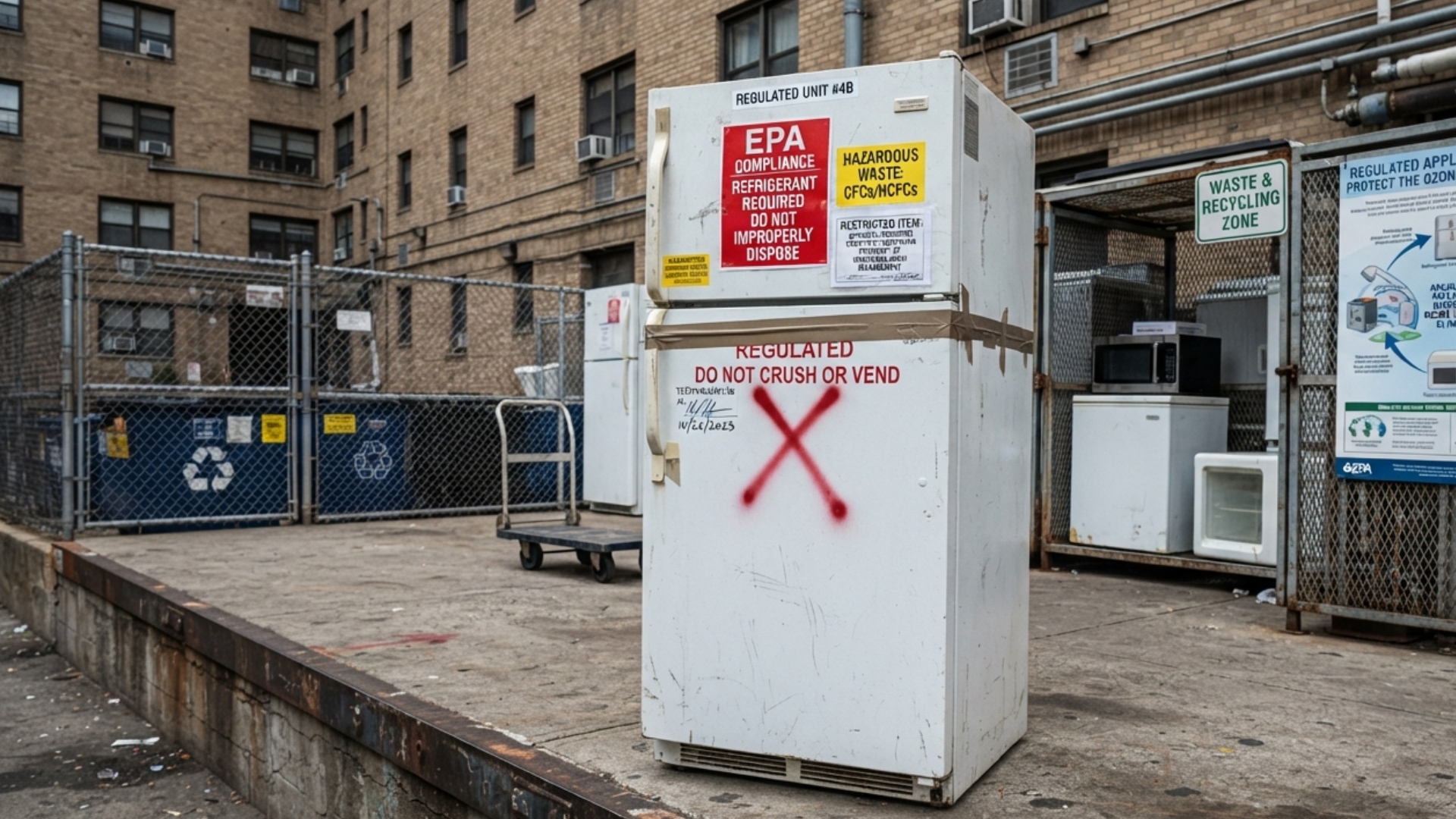
In every commercial kitchen, lab corridor, staff room, and shop floor stands the appliance everyone forgets is a chemical device: the fridge. It hums for fifteen years, asks for nothing, and then, at the end of life, becomes the single most regulated item in the building’s entire clearance.
The reasons are hidden in its walls. The refrigerant circulating in its veins and the blowing agents foamed into its insulation are potent greenhouse gases, and in older units, ozone-depleting ones. Puncture a circuit in a scrapyard and decades of climate diligence vent into the sky in an afternoon; landfill a foamed carcass and it leaks for years. Which is why fridges and freezers travel a dedicated, controlled route, and why the man with a van who will “take the old chiller off your hands” is offering to commit an environmental offence with your name attached.
Here is how compliant fridge disposal actually works, from the under-counter unit to the walk-in chiller, including the part nobody enjoys discussing: the contaminated ones.
Why The Gas Changes Everything
A fridge is a pressurised loop of refrigerant wrapped in gas-foamed insulation, and both gases matter enormously once the appliance stops being an appliance.
Older units carry the notorious CFCs and HCFCs of ozone-hole fame; newer ones carry HFCs and hydrocarbons, less stratospherically villainous but still, in the HFC case, greenhouse gases hundreds to thousands of times more potent than carbon dioxide, weight for weight. The law therefore requires controlled recovery: units go whole to specialist plants where refrigerants and blowing agents are extracted under sealed conditions before the steel, aluminium, plastics, and compressor metals are separated for recycling, the same material-recovery story our what-is-inside-your-electronics guide tells, with an extra containment chapter at the front.
For the business disposing, the compliance is pleasantly simple because the burden sits with the route, not with you: use a licensed collection, get the documentation as evidence of disposal, and file it with the rest of the WEEE paperwork our basics guide describes. What the rules will not forgive is the shortcut: fridges in general skips, gas circuits snipped for easier stacking, or the informal collector whose “recycling” is a hammer and a weighbridge.
Scale changes logistics, not principle. Household and under-counter units palletise; catering banks, laboratory refrigeration, and walk-in chillers and cold rooms need planned removal, panel-by-panel where necessary, which is exactly the professionally planned, hassle-free removal we quote after seeing photographs or a site visit. Mainland UK, Glasgow and Edinburgh included, on confirmed dates, typically within 5 to 7 working days.
The Contamination Rule Nobody Warns You About
Now the part that catches labs, hospitals, care homes, schools, and more than a few catering businesses completely off guard.
Refrigeration contaminated with clinical, biological, or laboratory materials must not be collected as waste until it has been certified decontaminated. No compliant carrier may load it; no compliant plant may accept it. The same rule applies in practice to the foul end of ordinary life: units heavy with mould, rotted contents, or serious malodour.
The logic is straightforward: the people handling and processing that unit downstream deserve not to meet your pathogens, chemicals, or biology experiment, but the practical effect is a trap: the lab fridge, the pharmacy unit, the vaccine chiller, the abandoned kebab-shop freezer, all legally frozen in place, unloadable, until someone deals with what is inside and on them.
This is why a combined decontamination and collection service exists, and why it is one of the most quietly appreciated things we do. Trained operatives attend in full PPE, deal with contents and contamination, certify the unit clean, and take it away for compliant gas recovery and recycling in the same visit, with the certification and disposal paperwork issued together. The locked freezer of unknown history, a genre every facilities manager eventually inherits, goes from unmentionable to solved in about an hour, which is precisely how one of our customers described watching it happen.
For laboratory and medical settings, the assumption runs the safe way around: clinical and lab refrigeration is treated as contaminated until certified otherwise, so the disposal conversation starts with decontamination rather than discovering the requirement at the kerb. Anything alongside the fridge, the lab’s chemical stock, the clinical waste stream, routes through the appropriate specialist services in the same coordinated plan.
The End-Of-Life Playbook For Cold Equipment
For the business with cooling equipment to move, the sequence that works every time:
- Empty and record. Contents disposed through their proper streams: food waste, clinical, chemical, and for regulated stock, the disposal recorded. Never leave contents for “the collection to sort out”; that is how units get refused at the door.
- Declare the history honestly. What did it store? Lab reagents, medicines, biological samples, or last month’s milk? The answer decides whether decontamination and certification come first, and honesty here is protection, not pedantry.
- Defrost where practical, secure the doors, leave the gas alone. No snipped circuits, no DIY compressor removal, no laying units flat and cracking the loop. The gases are the whole point of the controlled route.
- Book the right-shaped collection. Photographs, dimensions, and access notes for the big kit; a combined decontamination visit where step two says so; pallets and positioning for volume clearances. Confirmed date, tracked vehicle, done.
- File the evidence. Disposal documentation and decontamination certificates where issued, into the compliance folder. If the unit was part of a larger clearance, our office refresh playbook shows where this file joins the rest.
Replacement day is the natural trigger: the new chiller’s delivery and the old one’s compliant departure book beautifully as a single choreography, and the kitchen never runs cold.
Frequently Asked Questions About Fridge And Freezer Disposal
Why are fridges a special waste stream?
Refrigerants and insulation gases are potent greenhouse gases requiring sealed recovery at specialist plants before the materials are recycled. The gas is regulated.
How do businesses dispose of commercial refrigeration?
Licensed collection, whole units, controlled gas extraction, material recycling, documentation back. From under-counter to walk-in chillers, planned and hassle-free.
What is the decontamination rule?
Clinically, biologically, or chemically contaminated refrigeration cannot be collected until certified decontaminated, and heavily fouled units are treated the same. Decontamination, certification, and collection combine into one visit.
Can a full or rotten fridge be collected?
Not as found. Contents route to their proper streams and the unit is decontaminated first, which the combined service handles start to finish.
Do lab and medical fridges need special handling?
Yes: assumed contaminated until certified, then the standard controlled route. Plan disposal with the history declared up front.
Where and how fast do you collect?
Mainland UK from Bedford to Glasgow and Edinburgh, confirmed dates, typically 5 to 7 working days, with site-planned removals for walk-ins and banks of units.
Let The Cold Chain End Properly
Every fridge your business owns will eventually need this route, and the compliant version costs a phone call while the shortcut version costs the atmosphere, and occasionally a prosecution.
Priority WEEE removes and recycles refrigeration of every type, shape, and size, decontamination certified where needed, gases recovered, materials recycled, and paperwork delivered. Call 0800 078 9580 or request a free review at priorityweee.co.uk, and retire the hardest-working appliance in the building with its dignity, and your compliance intact.
