
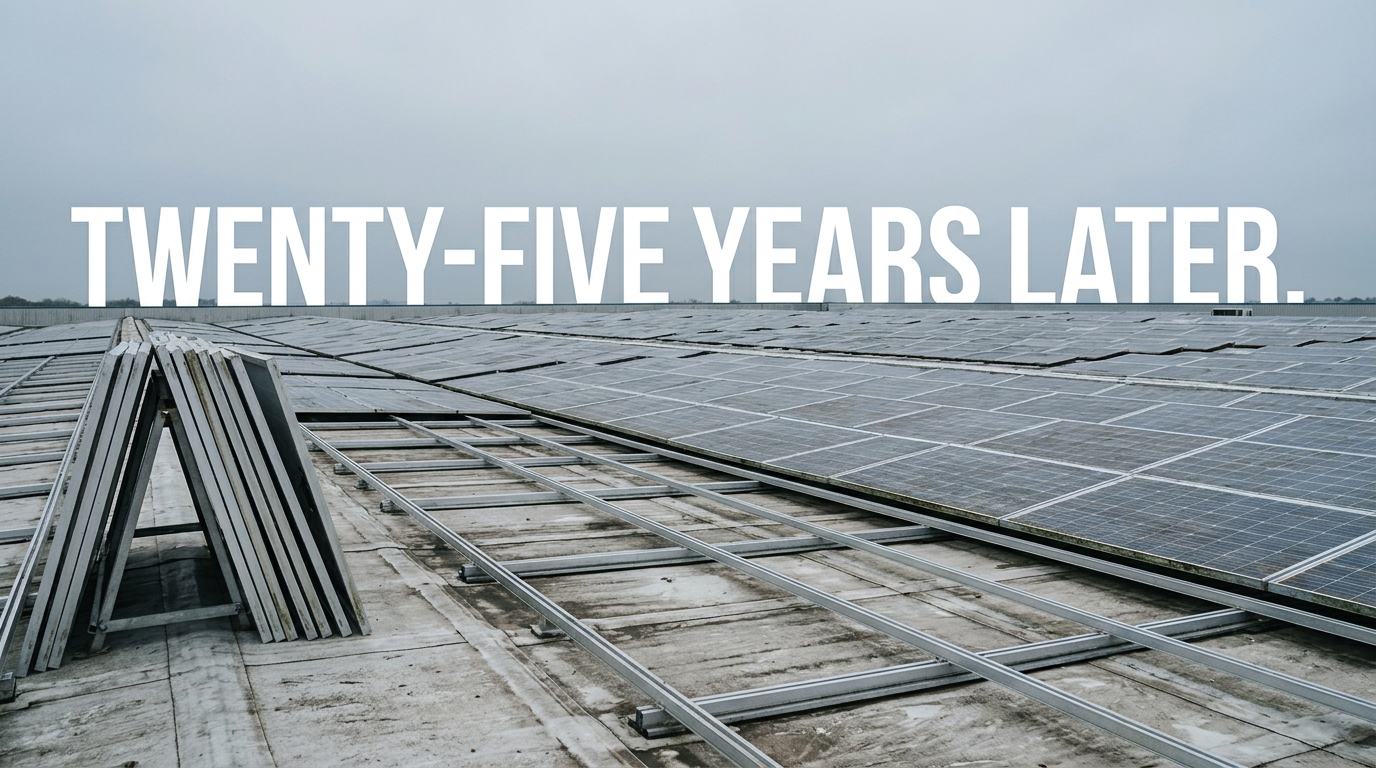
The UK’s first big wave of commercial solar went up between 2010 and 2015, driven by the feed-in tariff. Warehouse roofs, farm buildings, factory units, school halls.
Those arrays were sold on a twenty-five-year performance warranty. The oldest of them are now well past the halfway mark, and a steady number are coming down early because the roof underneath needs replacing, the building has changed hands, or a panel batch has failed.
Almost nobody who commissioned those systems planned for what happens at the end. It is arriving anyway.
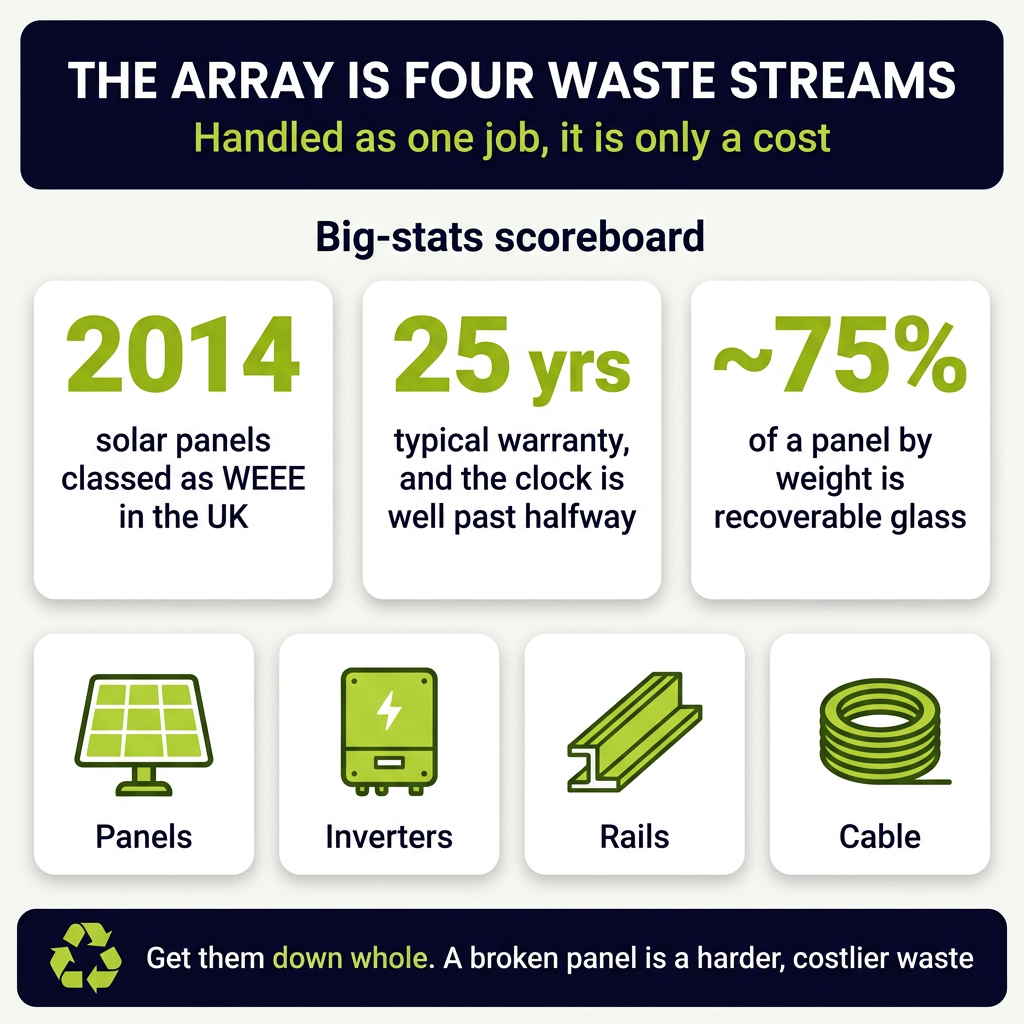
Solar panels are WEEE, and have been since 2014
This is the fact most building owners do not know. Photovoltaic panels were brought into the scope of the WEEE regulations in the UK in 2014.
That has two consequences.
They cannot go in a skip or into construction waste. A decommissioned array is waste electrical equipment and must go to an approved treatment facility through a licensed carrier, with the paperwork that implies.
The producer may be obliged to fund the treatment. For panels placed on the UK market from 2014 onwards, the producer carries financing responsibility for end-of-life treatment. If your array went up after that date, the manufacturer or importer may owe you the recycling, and the first thing to do is check who registered them.
For arrays installed before 2014, that route usually will not exist, and the cost sits with the building owner.
An array is four waste streams, not one
Decommissioning gets priced badly because people quote it as “solar panel removal”. A typical commercial rooftop system produces at least four distinct streams, and the value in one can offset the cost of another.
The panels themselves. Roughly three-quarters of a standard crystalline silicon panel by weight is glass, with an aluminium frame, a copper and silver conductor layer, silicon cells and a polymer backsheet. Specialist processing separates these. The aluminium and glass carry recoverable value.
The inverters. These are substantial pieces of electrical equipment in their own right, full of copper, aluminium and circuit boards. They are WEEE, and they have real material value. Do not let them go in with general scrap.
The mounting system. Aluminium rails and stainless steel fixings. This is the stream that most often surprises people, because aluminium rails across a large roof add up to a meaningful metal rebate if it is separated rather than mixed.
Cabling. DC string cable is copper, and copper is the highest-value non-ferrous metal on the job. Kept separate and uncut, it is worth considerably more than it is bundled into a mixed skip.
Any battery storage. If the system has storage attached, that is a lithium battery installation and a completely separate hazardous route, with its own transport and containment rules.
Handled as one job, an array is a cost. Handled as four segregated streams, a large commercial decommissioning can recover a serious proportion of that cost.
Getting the panels down without creating hazardous waste
Intact panels and broken panels are not the same waste.
A whole panel is standard WEEE. A shattered panel is a different proposition: laminated glass fragments bonded to polymer, contaminated, difficult to process, and in some cases classified differently depending on the cell chemistry. Thin-film panels in particular can contain cadmium compounds, which shifts them firmly into hazardous territory.
So the handling rule is straightforward. Get them down whole, keep them whole.
- Stack panels vertically on edge in purpose-made A-frames or stillages, not flat in a pile. Flat stacking cracks the cells under load.
- Interleave with the original packaging or board where you have it.
- Do not drop, slide or lever panels off rails. Most breakage happens in the last metre.
- Cover the stack. Rain does not destroy a panel, but it makes the pallet heavier and the handling worse.
- Identify the panel type before you start. Crystalline silicon and thin-film go down different routes. The datasheet or the label on the back of the panel tells you which you have.
Working at height, which is the real constraint
Solar decommissioning is a roof job before it is a waste job, and that dictates the timeline and most of the cost.
Scaffold or mobile access, a roof condition assessment, fragile roof precautions, and safe lowering of several hundred rigid panels are all planned work. The waste containment has to be on site and positioned before anyone goes up, because there is nowhere to put panels mid-strip if it is not.
Two sequencing points that save money:
Electrically isolate and certify first. A live DC array is a hazard even when the inverter is off, because the panels generate whenever there is light on them. This is qualified work, and it books ahead.
Decide reuse before removal, not after. Working panels have a secondary market. Once a panel is off the roof and stacked badly, it is scrap. If any of the array is likely to be resaleable, that changes how it comes down, and it needs deciding at the survey.
If you are installing rather than removing
Most readers of this will be somewhere in the middle: an existing array with years left, or a new installation being planned.
Three things to put in writing at purchase:
- Who is the registered producer for these panels, and are they in a compliance scheme? This determines whether end-of-life treatment is funded.
- What does the installer’s contract say about removal and disposal at end of life? Most say nothing, which means the cost is yours by default.
- Keep the panel datasheets and the array schedule on file. In twenty years, whoever takes them down will need to know the panel type and count. Nobody will be able to find it if it was not filed at the start.
That third point sounds trivial. It is the single most useful thing you can do for whoever inherits the building.
Frequently asked questions
Can solar panels be recycled in the UK?
Yes. Solar panels have been classified as waste electrical and electronic equipment in the UK since 2014, and must be treated at an approved facility. Specialist processing separates the glass, aluminium frame, silicon and metal conductors so the materials can be recovered rather than landfilled.
Who pays to dispose of commercial solar panels?
For panels placed on the UK market from 2014 onwards, the producer carries financial responsibility for end-of-life treatment, so the manufacturer or importer may fund the recycling. For arrays installed before 2014, the cost usually falls to the building owner. Check who registered the panels before assuming you are paying.
Can solar panels go in a skip?
No. Decommissioned panels are waste electrical equipment and must go to an approved treatment facility via a licensed carrier with waste transfer documentation. Putting them in a general or construction skip breaches your duty of care, and broken thin-film panels can be classified as hazardous waste.
Does a solar array decommission have any recoverable value?
Often, yes. The aluminium mounting rails, the copper DC cabling and the inverters all carry real material value, and the panels themselves contain recoverable aluminium and glass. The value only materialises if the streams are separated during the strip-out rather than mixed into one skip, so agree the segregation plan before work starts.
How should solar panels be stored after removal?
Vertically on edge in A-frames or purpose-made stillages, interleaved and covered, never stacked flat. Flat stacking cracks cells under load, and a broken panel is harder and more expensive to process than an intact one. Get the containment on site before the strip-out begins.
The bottom line
The first generation of UK commercial solar is reaching the age where roofs need attention and arrays come down. The projects that go well are the ones where the waste plan existed before the scaffold did.
Find out who the registered producer is, plan the four streams separately, and get the panels down whole.
Priority WEEE handles solar array decommissioning waste nationally, including panels, inverters, mounting metal and cabling, with segregated streams and full documentation. Book a free site survey, and we will price it stream by stream.
