
A migration to the cloud finishes. Twelve racks of kit in a room nobody visits are suddenly redundant.
The instinct is to treat it as a clearance job. Get a van, get it out, get the room back.
That instinct is how organisations end up unable to answer a simple question eighteen months later: where did drive number 4,127 go? Server rooms are the highest concentration of sensitive data and recoverable value most businesses will ever dispose of in one go, and the difference between doing it well and doing it badly is measured in both directions.
Start with the register, not the removal
Nothing should be unplugged until you know what is in the room. Not roughly. Exactly.
Build a line-by-line register covering:
- Every device, by make, model, serial number and asset tag
- Every drive, separately from its host, because drives get swapped over a rack’s life and the asset tag on the chassis does not tell you what is inside it
- What each device did, so you know its data sensitivity
- Whether it is live, dormant or already dead
- Ownership, because leased equipment, supplier-owned hardware and kit belonging to a client all have different endings
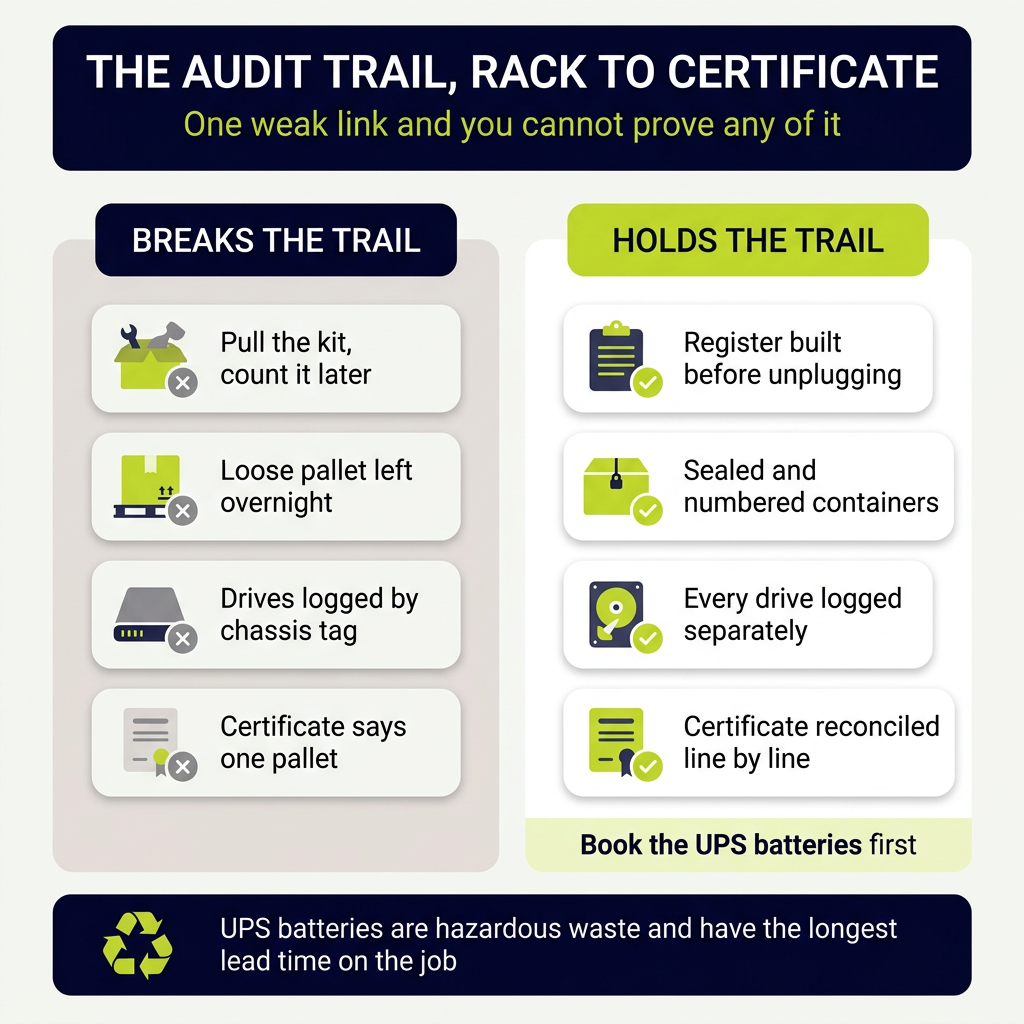
That drive-level detail is the whole game. Your certificate of destruction at the end has to reconcile against this register, device for device. If the register is vague, the certificate cannot be specific, and you have no audit trail.
Watch for the machines nobody claims. Every server room has two or three boxes that have been running for years, and nobody can say what they do. Find out before you power them off, not after.
The order of operations
- Confirm nothing live depends on it. Sounds obvious. In practice, there is almost always one forgotten service, a licence server, a backup target, a scheduled job, still pointing at a box in that rack. Monitor traffic on everything for a period before you commit.
- Take final backups and verify the restore. A backup that has never been restored is a hope. Verify it while the source hardware still exists, because after decommissioning there is no going back.
- Deal with licensing and support contracts. Software licences tied to hardware, maintenance contracts, and support agreements all need cancelling or transferring. This is a cost saving people forget to claim.
- Wipe what can be wiped, in place, before anything moves. The safest drive is one already sanitised while still inside your building. Where equipment is going for resale and the schedule allows, verified overwriting in situ removes most of the transport risk.
- Power down and label. Every item gets labelled against the register as it comes out of the rack. Unlabelled equipment on a pallet is the moment the audit trail breaks.
- Separate the streams before anything is loaded.
- Load into sealed, numbered containers, with the container numbers recorded against the register.
- Reconcile the certificates against the register when they come back.
The four streams coming out of a server room
Data-bearing equipment. Servers, storage arrays, individual drives, backup tapes. This goes to a documented destruction or verified sanitisation route with serial-level certification. Nothing here goes with general WEEE.
Non-data-bearing IT. Rack frames, PDUs, KVM switches, cable management, blanking panels. Standard WEEE, and the rack frames themselves are substantial steel with genuine scrap value.
UPS batteries. This is the stream that catches people out, and it deserves its own section below.
Cabling. A server room contains an enormous quantity of copper. Structured cabling, power cable, patch leads. Kept separate and uncut, it is one of the more valuable things leaving the building. Bundled into a mixed skip, it is worth nothing.
There is a fifth item that is not waste at all: equipment with resale value. Recent servers, storage and network hardware have a real secondary market. A provider who assesses this and credits it back is worth more than one who shreds everything and says nothing.
UPS batteries, which need planning weeks ahead
A room-scale uninterruptible power supply contains a large battery bank, and it is the single most constrained part of the whole job.
They are heavy, and they are live. A rack of sealed lead-acid cells holds serious stored energy and serious weight. Disconnection is qualified work, and the removal route out of the building has to take the load.
They are hazardous waste. Lead-acid and lithium battery banks both go under a consignment note, not a standard transfer note, and they need specific containment and transport arrangements.
Lithium banks are a different job again. Newer UPS installations increasingly use lithium chemistry, which brings transport classification requirements and fire risk controls that lead-acid does not. Establish which you have at the survey.
Book them first. Battery collection has the longest lead time of anything in a decommission, and a stack of disconnected cells sitting in a corridor for three weeks is both a fire risk and a compliance problem.
The same applies to any halon or gas suppression system in the room, which is separately regulated and needs a specialist.
Chain of custody, from rack to certificate
Chain of custody means being able to trace every data-bearing item from the moment it left the rack to the moment it was destroyed. Six links:
- Removed from rack, labelled against the register, signed by a named person
- Loaded into a sealed, numbered container, seal number recorded
- Collected, with the container numbers on the transfer note and a signature on both sides
- In transit, in a tracked vehicle
- Received at the facility, seal integrity checked and recorded
- Destroyed, with a certificate listing serial numbers, method, standard and date
Any break in that chain is the point a regulator will focus on. The most common break is between one and two: equipment stacked loose on a pallet overnight, uncounted, in a room that other people can reach.
Frequently asked questions
What is the first step in decommissioning a server room?
Building a complete asset register before anything is unplugged, covering every device and every drive by serial number, what each machine did, and who owns it. The certificate of destruction at the end has to reconcile against that register. Without it, you cannot prove where any individual drive went.
What happens to UPS batteries when a server room is decommissioned?
They are hazardous waste and move under a consignment note, not a standard waste transfer note. Disconnection is qualified work because the bank holds significant stored energy, and lithium banks carry additional transport and fire controls compared with lead-acid. Book battery collection first, as it has the longest lead time in the project.
Does decommissioned server equipment have resale value?
Often, yes. Recent servers, storage arrays and network hardware have an active secondary market, and rack frames and copper cabling carry material value even when the equipment does not. Value only survives if drives are sanitised rather than shredded and if equipment is handled carefully, so decide the reuse question before removal begins.
How do I prove the data on my servers was destroyed?
With a certificate of destruction listing individual serial numbers, the method used, the standard achieved and the date, reconciled line by line against your asset register. Add the chain of custody records: sealed container numbers, signed transfer notes and receipt confirmation. A certificate describing “one pallet of servers” does not meet this bar.
How long does a server room decommission take?
For a small room, a few weeks from survey to final certificate. For anything with a room-scale UPS, gas suppression or significant resale assessment, allow two to three months. The constraint is rarely the physical removal. It is the asset register, the battery collection lead time and the electrical isolation work.
The bottom line
A server room decommission is a documentation exercise that happens to involve lifting.
Build the register first, label everything as it comes out, seal and number the containers, book the batteries early, and reconcile the certificates against the register at the end. Do that, and the room empties and the audit trail holds.
Priority WEEE handles server room and data centre decommissioning nationally, with asset-level registers, sealed chain of custody, serial-level destruction certificates and UPS battery collection under consignment. Book a free site survey, and we will scope it rack by rack.
