
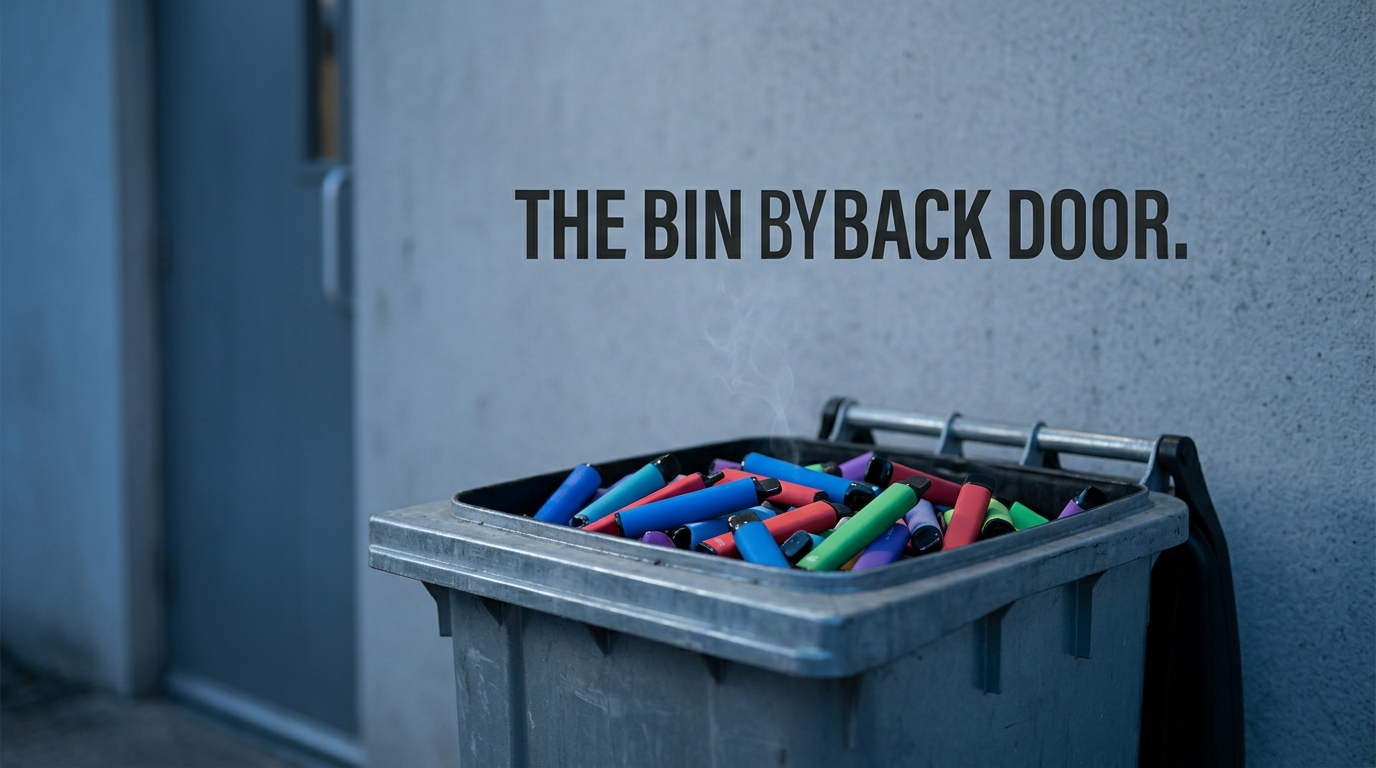
Walk out to the smoking area of almost any UK workplace and look in the bin. You will find vapes in it.
Not because anyone is being careless. Because there is nowhere else to put them, and nobody has ever said otherwise.
That bin is emptied into general waste, tipped into a compactor lorry, and every one of those devices contains a lithium cell that is about to be crushed. It is the most common ignition source in commercial waste, and it walks into your building in people’s pockets rather than arriving through procurement.
A vape is two regulated things at once
This is why it does not fit anywhere.
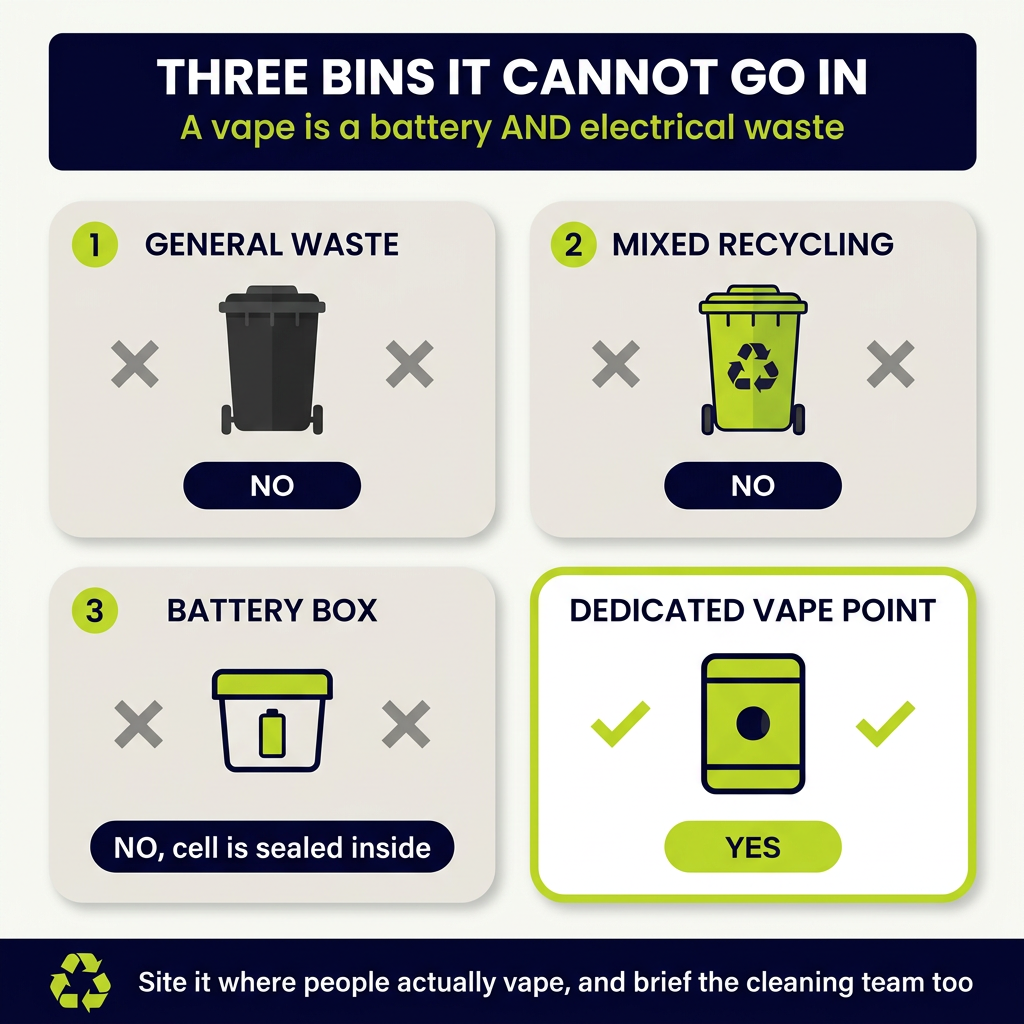
A disposable vape is waste electrical and electronic equipment, because it contains a circuit and a heating element. It is also a waste battery, because there is a lithium cell inside it.
Both classifications apply at the same time, and both prohibit general waste.
The awkward part is that it does not fit the ordinary battery box either. The cell is sealed inside a moulded plastic body, glued and press-fitted, and a standard battery recycler is not set up to open it. Put vapes in with the AAs, and you contaminate that stream too.
So there are three bins it cannot go in: general waste, dry mixed recycling, and the normal battery container. It needs its own collection point.
The fire risk, in plain terms
A lithium cell releases its energy slowly by design. Crush it, and it releases all of it at once.
Inside a bin lorry, the compaction ram applies several tonnes of force. That is more than enough to breach a vape casing and puncture the cell inside, which sends it into thermal runaway: rapid heating, venting of flammable gas, ignition, then the same happening to whatever is next to it.
Lithium fires generate their own oxygen, so smothering does not work the way it does on ordinary fires, and they can reignite hours later.
The risk starts before the lorry, too. A staff room bin full of vapes left overnight beside paper waste is an ignition source sitting on a fuel load.
What the ban did and did not change
The UK ban on the sale and supply of single-use vapes came into force on 1 June 2025.
It is worth being clear about what that means for a business, because it is widely misread.
It stopped the sale of new single-use devices. It did not make possession unlawful, and it did not remove the devices already in circulation.
Reusable and refillable vapes are still on sale, and they contain larger, higher-capacity lithium cells than the disposables they replaced. From a waste and fire perspective, the reusable device is the bigger battery, not the smaller one.
The waste obligations are unchanged. Every vape, disposable or reusable, remains WEEE and a waste battery at end of life.
So the ban reduced the volume arriving over time. It did not remove the need for a collection route, and for many workplaces the devices coming through now hold more energy than the ones that prompted the concern.
If you sell them, you have more duties
Retailers and hospitality venues selling vapes carry obligations beyond disposal.
As a distributor of electrical equipment, you must offer free take-back of equivalent waste equipment, and you must display information about separate collection on your premises or website.
If you import or rebrand vapes, you are a producer, with battery producer obligations and WEEE producer obligations, and there is no minimum threshold. Selling any quantity brings you into scope. Above the volume thresholds, you must join a compliance scheme.
Trading standards have been active on this, and the enforcement risk here is real rather than theoretical.
Setting up a collection point, which is a small job
This costs very little and removes the single most likely ignition source in your waste.
Put it where people vape. Not in a storeroom, not at reception. At the door where people actually stand. A bin thirty seconds out of the way does not get used, and one that does not get used achieves nothing.
Use a proper fire-retardant container with a small aperture. The small opening matters, because it stops the container from being used as a general bin, which is what happens to any open box.
Label it clearly and specifically. “Vapes and e-cigarettes only” works. “Batteries” does not, because people will add AAs and you will have contaminated it.
Tell people once, properly. Most staff have no idea vapes cannot go in a normal bin. A single short notice explaining why, with the fire risk in it, does more than any amount of signage.
Site it away from the building fabric and away from combustible waste. It is a container of lithium cells. Treat it like one.
Book a scheduled collection rather than waiting until it is full. A full container is a bigger fire load, and “we will call when it needs emptying” reliably becomes never.
Cover the customer-facing side too if you are a pub, café, gym or retailer. Your visitors are producing these as well as your staff.
Where else they turn up
Two places worth checking beyond the smoking area.
Cleaning waste. If your cleaners consolidate all bins into one sack on the evening round, everything above is undone by that single step. Brief the cleaning team directly, not just the staff.
Confiscated items, in schools, colleges and some workplaces. These accumulate in a drawer in an office and are frequently forgotten. That drawer is an unmanaged store of lithium cells, and it should be emptied into the proper container the same day.
Frequently asked questions
Can vapes go in general waste at work?
No. A vape is both waste electrical equipment and a waste battery, and both classifications prohibit general waste. It also cannot go in dry mixed recycling or a standard battery box, because the cell is sealed inside a plastic body that a normal battery recycler cannot open. Vapes need a dedicated collection point emptied by a licensed carrier.
Are disposable vapes banned in the UK?
The sale and supply of single-use vapes has been prohibited since 1 June 2025. The ban stopped new devices being sold, but it did not make possession unlawful, and it did not remove devices already in circulation. Reusable vapes remain on sale and contain larger lithium cells, so the disposal obligation has not gone away.
Why are vapes a fire risk in bins?
They contain lithium cells that release all their stored energy at once if crushed or punctured. Bin lorries apply several tonnes of compaction force, which is more than enough to breach the casing and send the cell into thermal runaway. Lithium fires generate their own oxygen, resist smothering and can reignite hours after appearing to be out.
Does my business need a vape bin?
If anyone on your premises uses a vape, staff or customers, yes. Without a dedicated point, the devices go in the nearest bin, which is a fire risk for your own bin store and for your waste contractor. A fire-retardant container with a small aperture, positioned where people actually vape, is inexpensive and solves it.
What are the rules if my business sells vapes?
Selling electrical equipment makes you a distributor, which means offering free take-back of equivalent waste devices and publishing information about separate collection. Importing or rebranding makes you a producer, with both WEEE and battery producer obligations, and there is no minimum threshold that exempts small volumes.
The bottom line
This is one of the cheapest risks a business can remove.
A fire-retardant container by the door people already use, labelled for vapes only, a short note explaining why, a word with the cleaners, and a booked collection. An hour of work, and the most likely ignition source in your waste stops arriving in your general bin.
Priority WEEE supplies vape and battery collection points for workplaces, retail and hospitality nationally, with fire-retardant containment and full waste transfer documentation. Book a free waste review, and we will size the collection to your site.
