
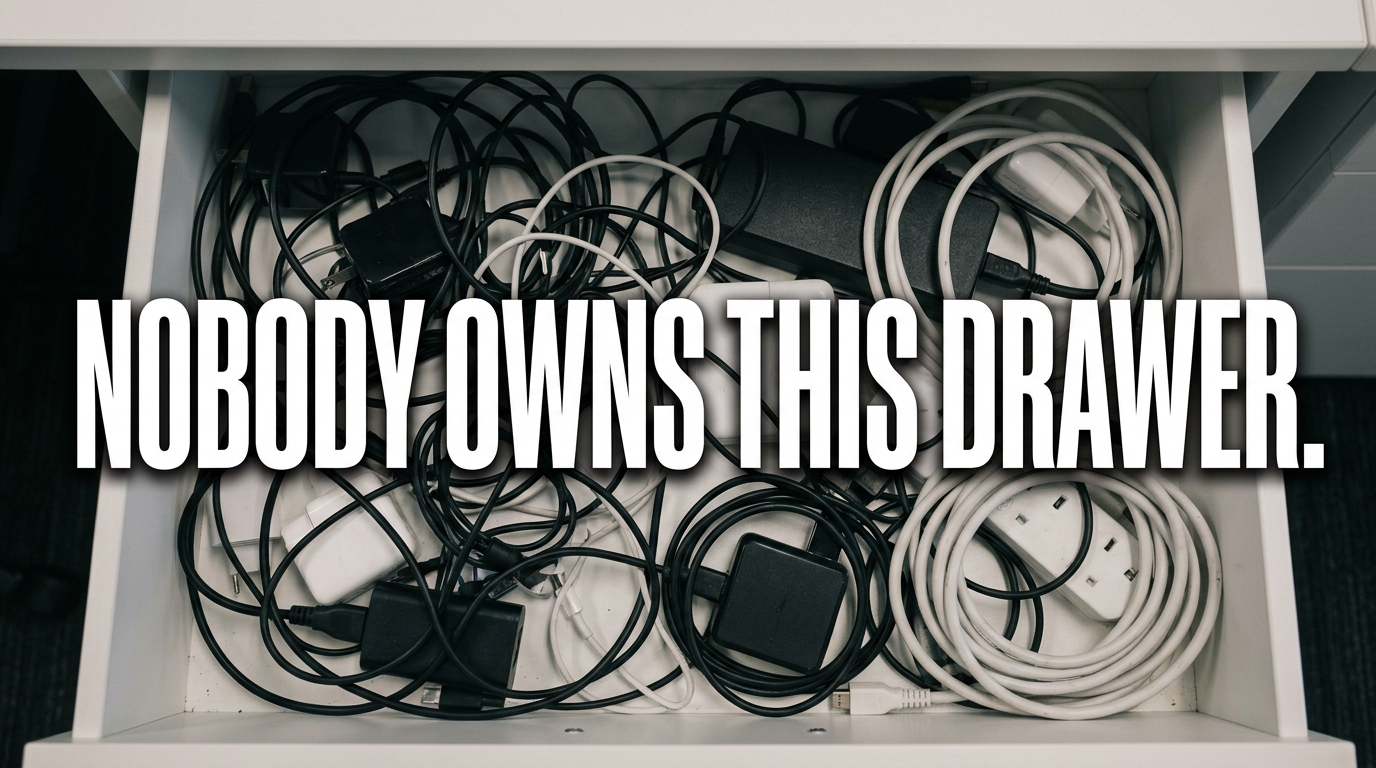
Every building has one. A deep drawer in a cupboard near the printer.
Inside there are phone chargers for handsets nobody owns, three HDMI cables and a laptop brick with no laptop. Under those sits a tangle of USB leads and a plug adapter from a conference in 2019.
Nobody uses it. Nobody throws it away either, because it feels wasteful and because nobody knows where it would go. So it grows.
All of it is waste electrical equipment
This is the part that surprises people, and it is the whole point.
A cable is WEEE. It carries current, so it falls under the WEEE Regulations 2013 like any other electrical item.
A charger is WEEE. It contains a transformer and a circuit board.
An adapter, a dock and a hub are WEEE. Small, cheap and disposable does not mean exempt.
So none of it belongs in general waste. Item size has never been the test.
The crossed-out wheelie bin symbol on the back of the plug says so. Most people have never looked.
Why the drawer exists at all
It is worth understanding, because the fix has to work around human behaviour rather than against it.
Nobody wants to bin something that still works. A working cable in a bin feels wrong, so it goes in the drawer instead.
Nobody knows whether it works. Testing a mystery charger takes longer than keeping it.
There is no obvious destination. The general bin feels wrong, and no other bin exists.
It is nobody’s job. Small electricals sit below the threshold where anyone owns the decision.
The drawer is a decision that never got made, repeated over several years.
What is actually in a typical one
Clearing one out produces a predictable list.
- Phone and tablet chargers, most of them obsolete connectors
- Laptop power supplies for models long since retired
- USB, HDMI, VGA, Ethernet and audio cables
- Docking stations, hubs and port replicators
- Travel adapters and extension leads
- Mice, keyboards and headsets
- Presentation clickers and webcams
- Power banks and spare batteries
- The occasional phone or tablet nobody logged
That last line is the one to watch. A handset in a drawer is a data problem as well as a waste one.
The items that need separating
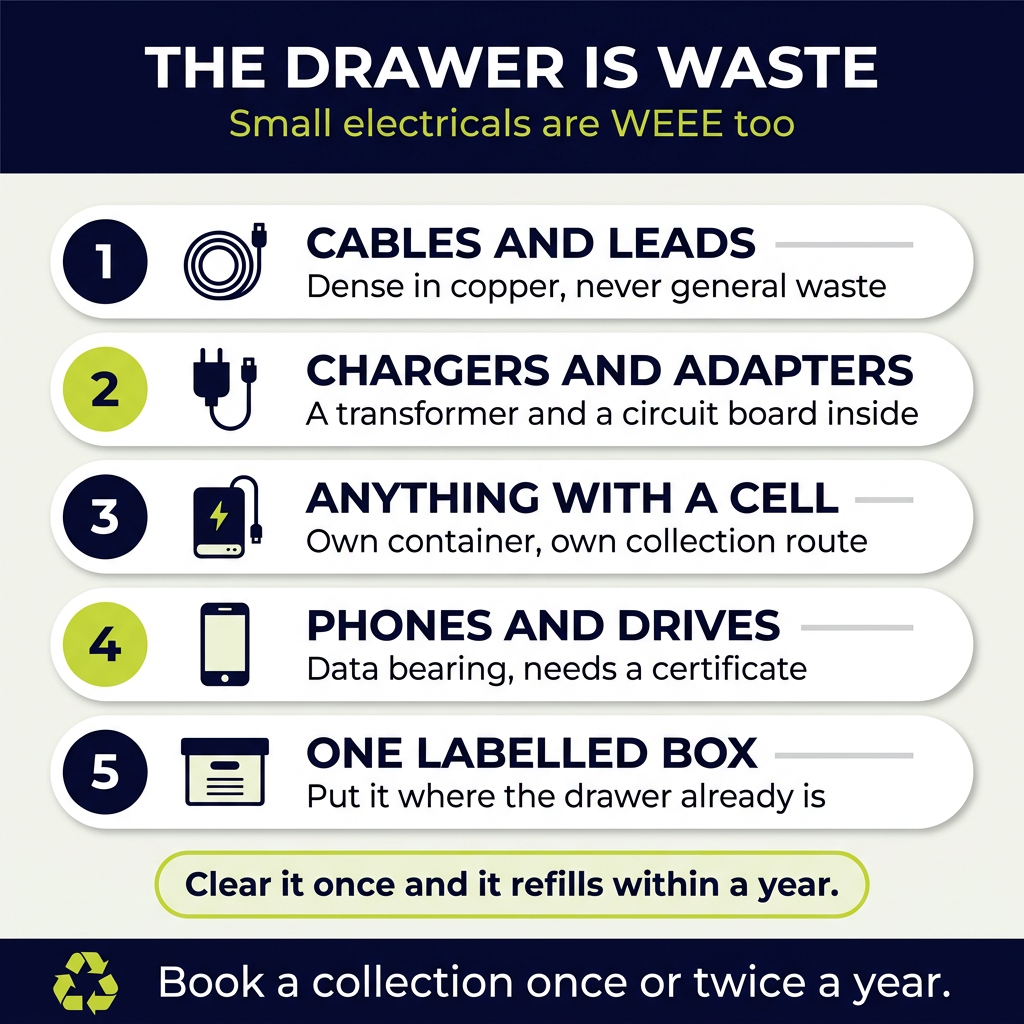
Most of the drawer goes down one route. Four things do not.
Anything with a battery in it. Power banks, wireless peripherals and spare cells go down the battery route, not with the cables.
Anything that stores data. Phones, tablets, USB sticks and drives need data destruction with a certificate.
Damaged or swollen batteries. These are an immediate fire risk and need isolating today, not on the next collection.
Anything still under a lease or asset register. Check before it leaves, because returning kit you scrapped is expensive.
Everything else goes as mixed WEEE on a single collection.
Why it matters more than the volume suggests
One drawer weighs very little. The argument for clearing it is not tonnage.
Cables are dense in copper. Copper is one of the materials that makes WEEE recycling worth doing, and it recovers cleanly.
Circuit boards carry precious metals. Small volumes, high value, all of it lost in a general bin.
Batteries in the drawer are an ignition source. A drawer of lithium cells in a warm cupboard is a fire risk sitting inside your own building.
The paperwork trail matters. Your duty of care applies to a box of cables exactly as it applies to a pallet of servers.
Our guide to what actually comes out of recycled electronics covers the materials side in full.
Setting up a point so the drawer stops refilling
Clearing the drawer once achieves very little. It refills within a year.
Put a container where the drawer is. Not in the yard, not in a storeroom. In the cupboard people already open.
Label it for what it holds. “Cables, chargers and small electricals” beats “WEEE”. That term means nothing to most staff.
Keep a small box for batteries. Different route, different container, marked as such.
Give one person the key job. Somebody has to decide when it goes, or it never goes.
Book it on a schedule. Once or twice a year suits most offices, and a scheduled visit beats waiting for a full box.
We supply containment sized for this job, including fire-retardant options for the battery box.
Working out what is worth keeping
Not everything in the drawer is waste. A short sort saves money on both sides.
Keep current standards in useful numbers. USB-C leads and standard kettle leads earn their shelf space.
Bin obsolete connectors without guilt. Nothing in your building takes a 30-pin dock connector.
Keep laptop supplies that match live models. Scrap the rest rather than storing them for a fleet you no longer run.
Set a limit. One small box of spares, not a drawer, not a cupboard.
Agree it with whoever fixes things. The person who repairs kit has a fair claim on a few spares, so let them pick which.
Anything that fails the limit test goes in the collection. Storing a spare you will never find again is not reuse.
The office move version of this problem
A relocation turns one drawer into forty boxes. It is the same job at a different scale.
Do the sort before the move, not after. Moving dead cables to a new building costs more than disposing of them.
Keep data-bearing items out of the removal lorry. They need their own chain of custody.
Book the WEEE collection as part of the move plan. Not as an afterthought when the new landlord asks.
Our office refresh playbook covers clearance at that scale.
The same applies to a floor refurbishment or a department closing. Any event that empties cupboards produces this in bulk.
Frequently asked questions
Are cables and chargers really classed as WEEE?
Yes. Anything that runs on mains power or a battery counts as electrical and electronic equipment. Cables, chargers, adapters and hubs all qualify.
Size does not exempt an item. The crossed-out wheelie bin symbol on the plug is the giveaway.
Can small electrical items go in general waste?
No. They fall under the WEEE Regulations and need collecting separately by a licensed carrier for treatment at an approved facility.
General waste also loses the copper and circuit board material that makes recycling these items worthwhile.
What do we do with power banks and wireless peripherals?
Anything containing a battery goes down the battery route rather than in with the cables, in a separate marked container.
Swollen or damaged cells need isolating immediately and collecting as a priority rather than on a scheduled visit.
Do old phones in the drawer need data destruction?
Yes, if they ever held company email, contacts or files. Treat any handset, tablet, USB stick or drive as data-bearing unless you can prove otherwise.
Ask for a certificate covering each device by serial number rather than one line describing a box.
How often should an office clear its electrical drawer?
Once or twice a year suits most sites. The point is a scheduled collection rather than a full container.
A permanent labelled box in the same cupboard stops the drawer refilling between visits.
Is there any value in a box of old cables?
Copper in the leads and precious metals on the circuit boards both recover, though a single office box is small.
The stronger argument is compliance and fire risk. The materials recovery is a bonus rather than the reason.
The bottom line
The drawer is not a tidiness problem. It is unbooked waste electrical equipment sitting in a cupboard, with a few lithium cells in it.
Put a labelled box where the drawer is and let people fill it without thinking.
Split the batteries into their own container, and pull out anything that ever held data.
Then book a collection once or twice a year, because the drawer refills whether or not anyone is watching.
Priority WEEE collects small electrical waste, cables, chargers and batteries from workplaces across the UK. Containment supplied, full waste transfer documentation. Book a free waste review, and we will size a collection point for your building.
