
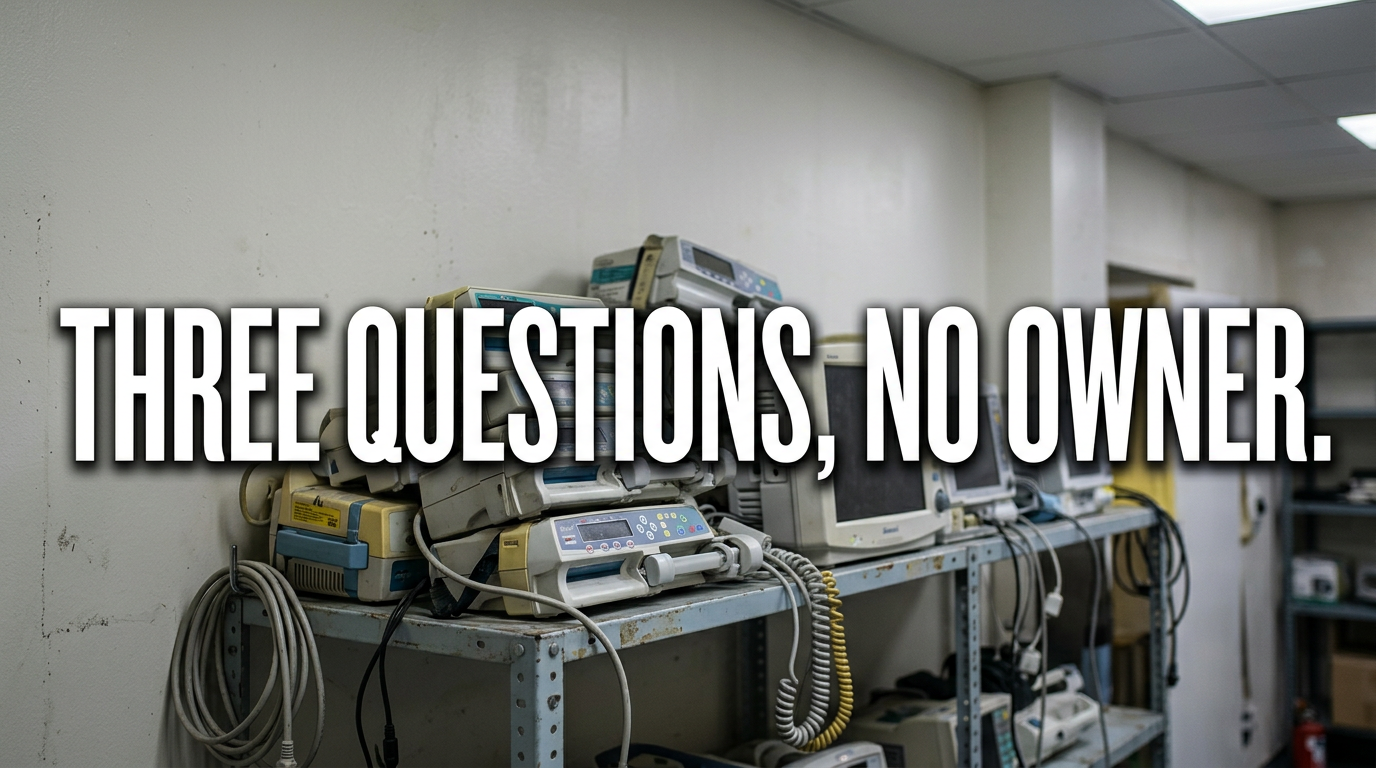
A ward replaces its infusion pumps. Twelve old units come off the floor and go into a storeroom.
Six months later they are still there. Nobody is certain what has to happen first.
Are they clean? Do they hold patient data? Who signs them off?
So they sit. They take up a room somebody needs, and the question waits for an owner.
Nobody is at fault. The job just has no obvious first step.
Clinical equipment is three problems in one item
That is why it stalls. A laptop has one question on it. A ward device has three.
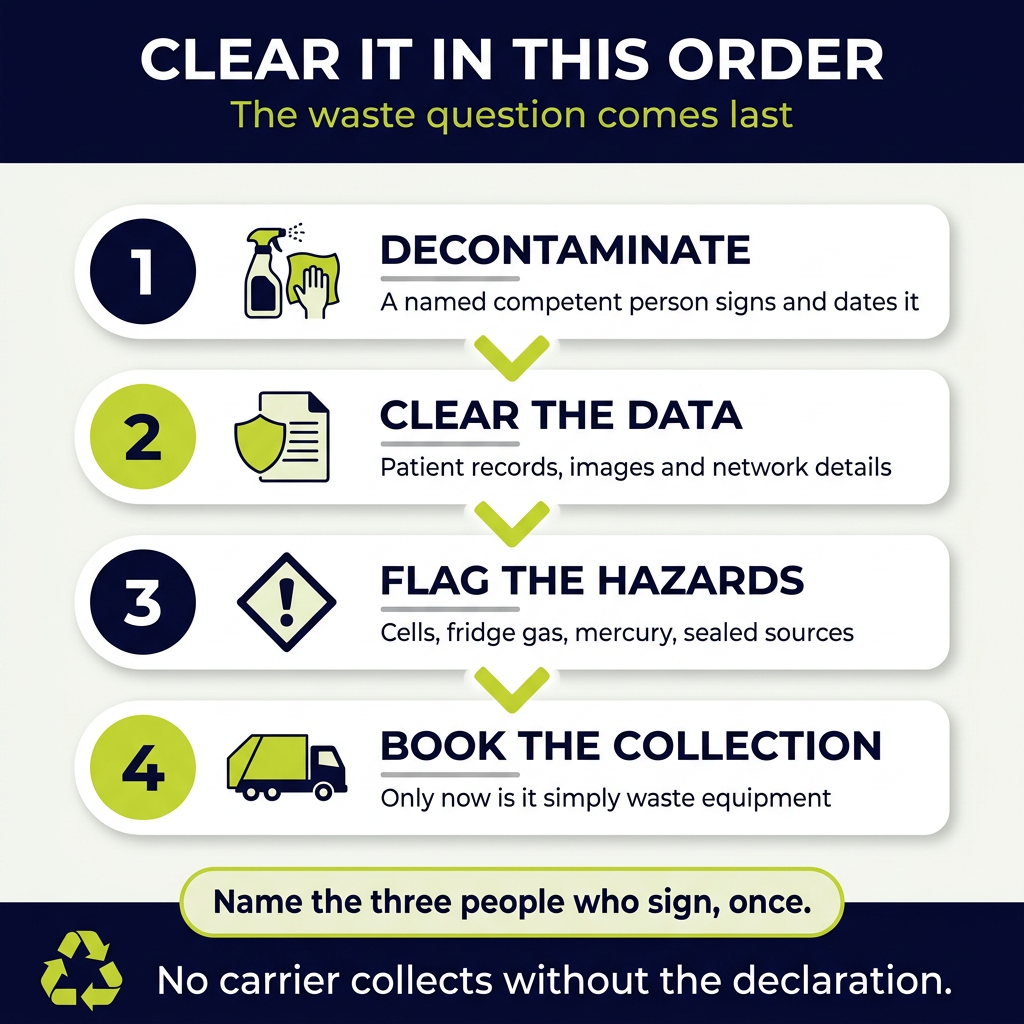
Has somebody decontaminated it? Nobody can handle it until a competent person says yes, in writing.
Does it hold data? Many devices store patient measurements, identifiers and treatment records.
Is it hazardous? Cells, sealed sources, mercury parts and fridge gas all turn up here.
Only then does it become WEEE. The waste question is the last one, not the first.
Answer them in that order and the storeroom empties. Take them out of order and nothing moves.
The equipment this covers
Wider than most people picture. It spans several departments.
- Infusion pumps, syringe drivers and feeding pumps
- Patient monitors, ECG machines and spirometers
- Ultrasound units and portable imaging equipment
- Dental chairs, compressors, X-ray units and curing lights
- Autoclaves and sterilisers
- Laboratory analysers, centrifuges and incubators
- Specimen and vaccine fridges and freezers
- Hoists, profiling beds and powered mobility equipment
- Hearing, optical and audiology equipment
- Nurse call systems and ward displays
Most of it runs on mains power or a battery. That makes all of it waste electrical equipment at end of life.
Decontamination comes before everything
No carrier should collect clinical equipment without this, and no reputable one will.
Somebody competent has to declare it. A named person, a date, and a statement covering the specific item.
It travels with the equipment. A label on the unit and a copy in the paperwork.
It keeps the handlers safe. Your driver, the treatment site, and the next person to open the crate.
Where cleaning is not possible, say so. Some equipment resists full decontamination, and that changes the route rather than blocking it.
Build the form into the removal job rather than chasing it later. Nothing can move without it.
The data nobody expects to find
Clinical devices are computers, and several store far more than staff assume.
Patient measurements and trends. Monitors and pumps often hold logs going back months.
Identifiers. Names, hospital numbers and dates of birth on any device tied to a patient record.
Treatment histories. Infusion settings, doses, and who administered them.
Network credentials. Anything joined to the site network holds connection details.
Images. Portable imaging and ultrasound equipment stores studies locally.
Treat every device as data-bearing until somebody proves otherwise. Our data destruction service issues certificates per device rather than per pallet.
What makes some of it hazardous
Four components turn a routine collection into a specialist one.
Batteries. Portable clinical equipment runs on sealed lead-acid or lithium cells, and both need the battery route.
Refrigerant gas. Specimen and vaccine fridges need degassing by someone qualified before anything else happens.
Mercury and older components. Legacy thermometers, sphygmomanometers and some lamps.
Sealed radioactive sources. Present in a small number of laboratory instruments, with an entirely separate regime.
Flag all four at booking. Finding them on the day stops the job and wastes the visit.
A quick walk round the store room catches most of it. Look for cells, cooling units and anything with a warning label.
Who owns the decision?
Kit stalls in store rooms because the choice has no owner. Three roles have to agree.
Clinical or laboratory staff confirm the equipment is out of service and decontaminated.
IT or information governance confirm the data position and what evidence is needed.
Estates or procurement own the asset record, the lease position and the physical removal.
Nobody outranks the others. All three have to sign before anything leaves.
Name the three people once, for the whole site. That one step clears more storerooms than any written process.
Put the names on the storeroom door. Then anyone can start the job.
Private practices have the same problem, smaller
A dental practice or a vet carries every one of these duties with none of the back office.
There is no governance team. The practice manager holds all three roles alone.
Kit costs a lot and lasts a long time. A chair swapped once in fifteen years catches nobody’s process.
Data is still data. Imaging and patient management systems hold records that need the same treatment.
The refurbishment is the trigger. Most practice equipment leaves during a refit, all at once.
Put the disposal in the refit plan. Do not find it when the builders turn up.
What to ask a carrier before you book
Five questions. The answers tell you fast whether they have done this before.
- What decontamination evidence do you require, and in what form?
- Will you issue a certificate per device, by serial number?
- How do you handle batteries, refrigerant and mercury components?
- Can I see your licences and accreditations?
- What happens to equipment that cannot be fully decontaminated?
A carrier who answers question one without pausing has collected clinical equipment before.
Reuse, where it genuinely applies
Some clinical equipment has life left in it, and throwing that away is a waste of a different kind.
Serviceable equipment can go for refurbishment. Where the manufacturer still supports it and parts exist.
Charities and overseas programmes take some categories. Though not as much as people hope, and not without support.
It still needs the same clearances. Decontamination and data removal apply to reuse and recovery alike.
Obsolete is obsolete. Kit nobody can service or calibrate is not a gift. It is a problem you passed on.
Be honest about which pile an item belongs in. Our IT recycling service checks for reuse before anything goes for recovery.
Frequently asked questions
Is medical equipment classed as WEEE?
Yes. Anything running on mains power or a battery counts as electrical and electronic equipment. That covers most clinical and laboratory devices.
The WEEE question comes last, though. Decontamination, data and hazardous components all come first.
What decontamination evidence do we need?
A dated declaration from a competent person, naming the specific item. It travels with the equipment, with a copy in the paperwork.
No carrier should collect clinical equipment without it, and reputable ones will decline.
Do clinical devices hold patient data?
Many do. Monitors, pumps and imaging equipment store measurements, identifiers, treatment settings and sometimes images locally.
Treat every device as data-bearing until somebody confirms otherwise, and ask for a certificate per device.
What about specimen and vaccine fridges?
They contain refrigerant gas and need degassing by a qualified person before anything else happens to the unit.
Flag them at booking, because they need a different handling route from general equipment.
Who signs equipment off for disposal?
Three roles, and all three have to agree. Clinical or laboratory staff on decontamination, IT or information governance on data, and estates or procurement on the asset position.
Naming those three people once, for the whole site, clears more storerooms than any written process.
Can old clinical equipment be donated?
Sometimes, where it still works, and somebody can support and calibrate it.
Decontamination and data removal apply either way, and obsolete equipment with no parts supply is not a useful donation.
How do small practices handle this?
The same duties apply with one person holding all three roles. Plan disposal into the refit programme, because that is when most practice equipment leaves.
Ask the carrier the same five questions a hospital would ask.
The bottom line
Clinical equipment stalls because three questions arrive at once and none of them belongs to one person.
Settle decontamination first, then data, then hazardous components. The waste question is the easy one at the end.
Name the three people who sign, once, for the whole site.
Then book the collection with a carrier who asks about decontamination before they ask about tonnage.
Priority WEEE collects medical, dental and laboratory equipment from healthcare settings across the UK. Per-device certificates, with specialist handling for batteries and refrigerant. Book a free waste review, and we will start with the storeroom.
