
Most businesses assume WEEE is a disposal question. Something that happens at the end, when the equipment dies.
For a surprising number of companies, it starts at the other end. Put your name on an electrical product, or import one to sell, and you take on an obligation.
It applies whether you make thousands of units or a few dozen. There is no small business exemption.
What makes you a producer
Five situations, and any one of them puts you in scope.
You manufacture and sell equipment under your own brand in the UK. The obvious case.
You resell somebody else’s equipment under your own brand. Rebadging a product makes it yours for these purposes.
You import equipment into the UK to sell it. Bringing it in for trade is the trigger.
You are based outside the UK and sell directly to UK customers. Distance selling into the UK counts.
You run an online marketplace supplying equipment to UK households from non-UK sellers.
The second and third catch the most businesses. A firm that imports a container of own-label products has become a producer without a meeting ever happening.
The kinds of businesses caught by surprise
It is seldom an electronics company. More often a firm that sells something else and happens to carry an electrical line.
- Promotional goods suppliers with branded power banks and speakers
- Hospitality groups importing own-label appliances for their sites
- Furniture retailers whose range includes lit or powered items
- Beauty brands with heated tools and devices
- Fitness and wellness companies importing equipment
- Toy and gift businesses with anything that lights up or plays sound
- Trade suppliers rebadging tools under their own name
- Anyone selling into the UK from abroad through their own website
If the product runs on mains power or a battery, it counts as electrical and electronic equipment.
The five tonne line
One number decides which route you take. It is the weight of equipment you place on the UK market in a year.
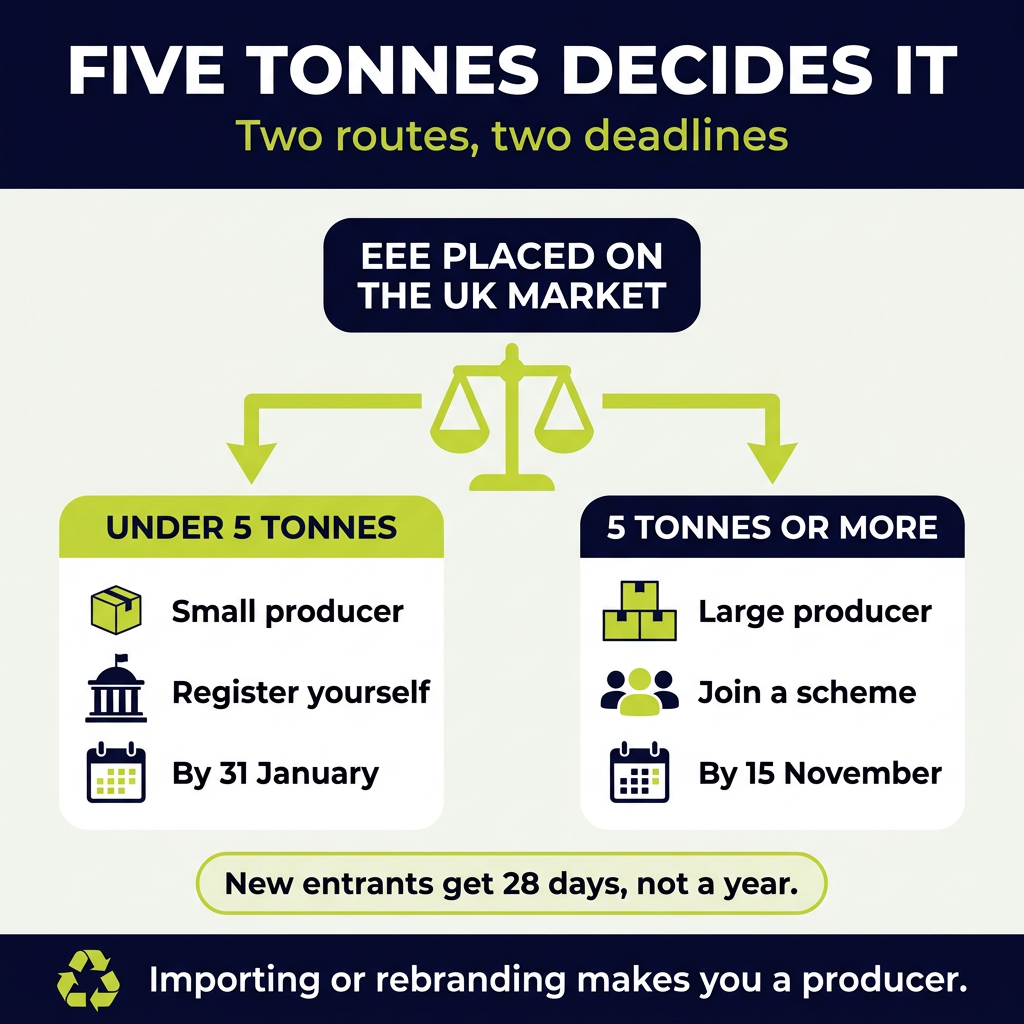
Under five tonnes a year makes you a small producer. You register with your environmental regulator through the WEEE online service.
Five tonnes or more makes you a large producer. You must join a producer compliance scheme.
The scheme takes on the obligation. It funds the collection, treatment, recovery and disposal of the equivalent tonnage.
Your location picks the regulator. The Environment Agency in England, Natural Resources Wales, SEPA in Scotland, and the Northern Ireland Environment Agency.
Weigh the equipment, not the packaging. Count what reached the market rather than what you ordered.
Two deadlines that catch people out
The dates differ by producer size, and missing one is the most common failure.
Small producers register by 31 January each year. Or within 28 days of placing equipment on the market for the first time.
Large producers join a compliance scheme by 15 November each year. Or within 28 days of a later market entry.
New entrants have that 28-day window. Which is short if nobody in the business knows the rule exists.
The obligation is annual. Registering once does not cover you for later years.
Put both dates in the compliance calendar alongside your other annual returns.
What producers actually have to do
Registration is the start rather than the whole job.
Record what you place on the market. By equipment category and weight, kept in a form you can produce.
Report it. Through the scheme for large producers, or directly for small ones.
Finance the equivalent recovery. That is what the compliance scheme fee buys.
Mark your products. The crossed-out wheelie bin symbol, and the producer mark identifying you.
Give distributors and treatment facilities the information they need. Including what is inside the product and how to treat it.
Keep the market data as you go. Reconstructing a year of it in January is painful and rarely accurate.
Batteries are a separate registration
This is where businesses that did the WEEE work still get caught.
Batteries have their own regime. The Waste Batteries and Accumulators Regulations sit alongside the WEEE rules.
Selling a device with a battery in it can put you in both. The appliance under WEEE, the cell under the battery rules.
Supplying loose batteries brings its own obligations. With no minimum threshold worth relying on.
The thresholds and deadlines do not line up. Two calendars, not one.
Our guide to business battery recycling covers the waste side, and battery collection covers the service.
Where distributor duties sit alongside this
Many businesses hold both roles at once and only know about one.
Producer duties come from placing equipment on the market. Making, importing, rebranding.
Distributor duties come from selling it. That means offering customers free take-back of the old item.
A firm importing an own-label range and selling it direct holds both. Two obligations, two records.
The thresholds differ. Take-back has no volume threshold. Producer registration has the five tonne line.
If you import and sell, work through both sets rather than assuming one covers the other.
Getting compliant from a standing start
If you have just realised you are in scope, the sequence is straightforward.
- Work out which of the five producer situations applies to you.
- Weigh a year of equipment by category, using actual sales data.
- Decide whether you are above or below five tonnes.
- Register directly or approach a compliance scheme, whichever applies.
- Check whether any of it brings battery obligations as well.
- Fix the product marking on the next production run.
- Set up a record that captures market data as you go.
Step two is the work. The rest follows from it in days rather than weeks.
Frequently asked questions
Does importing electrical goods make my business a WEEE producer?
Yes. Importing equipment into the UK for trade makes you a producer. So does selling somebody else’s equipment under your own brand.
Manufacturing under your own brand, distance selling into the UK and running a marketplace for non-UK sellers all count too.
What is the five tonne threshold?
It is the weight of equipment you place on the UK market in a year. Below five tonnes, you are a small producer and register with your environmental regulator yourself.
At five tonnes or above, you are a large producer and must join a producer compliance scheme.
When do we have to register?
Small producers register by 31 January each year, or within 28 days of first placing equipment on the market.
Large producers join a compliance scheme by 15 November each year. A later market entry gives you 28 days.
Is there a small business exemption?
No. The five-tonne line changes the route, not whether the obligation applies.
A business placing a small quantity on the market still registers, on its own rather than through a scheme.
What does a producer compliance scheme do?
It takes on your obligation to finance the collection, treatment, recovery and sound disposal of an equivalent tonnage.
It also handles the reporting. You still need accurate market data to give it.
Do batteries count separately?
Yes. Waste batteries carry their own regulations, their own thresholds and their own deadlines.
A device with a cell inside it can bring you into both regimes at once, so check each one.
What if we have been non-compliant for years?
Work out your position, gather the market data and approach the regulator or a scheme. Voluntary disclosure is a better footing than being found.
Fix the product marking on the next run rather than recalling stock.
The bottom line
Producer status arrives without announcement. Nobody sends a letter when you import your first own-label appliance.
Work out which of the five situations applies, then weigh a year of equipment properly.
Five tonnes decides your route, and the two deadlines belong in the compliance calendar rather than somebody’s memory.
Then check the battery position on its own. A device with a cell in it sits under two regimes at once.
Priority WEEE works with producers, importers and own-brand retailers on the waste side of these obligations. That covers take-back returns and end-of-life stock. Book a free waste review, and we will map what your range actually generates.
Source: GOV.UK, electrical and electronic equipment producer responsibility
