
A customer buys a kettle from you. They ask what to do with the old one.
The honest answer, for most UK retailers, is that they have no idea. The staff member shrugs, the customer takes it home, and it ends up in a black bin.
That exchange is a compliance failure, and it happens thousands of times a day.
What the rule actually says
The obligation is narrower than people fear and broader than most retailers realise.
If you sell electrical equipment, you are a distributor. That applies whether you are a shop, a trade counter, a website or a catalogue.
You must give customers a free way to dispose of the old item. That applies when they buy a new version of the same thing.
It applies to every sales channel. In-store, online, mail order and telephone all count the same.
It is like for like. A customer buying a fridge can hand back a fridge, not a laptop.
The government guidance on distributor responsibilities sets out the position in full.
The three ways to comply
You choose the route. All three are legitimate, and the right one depends on what you sell.
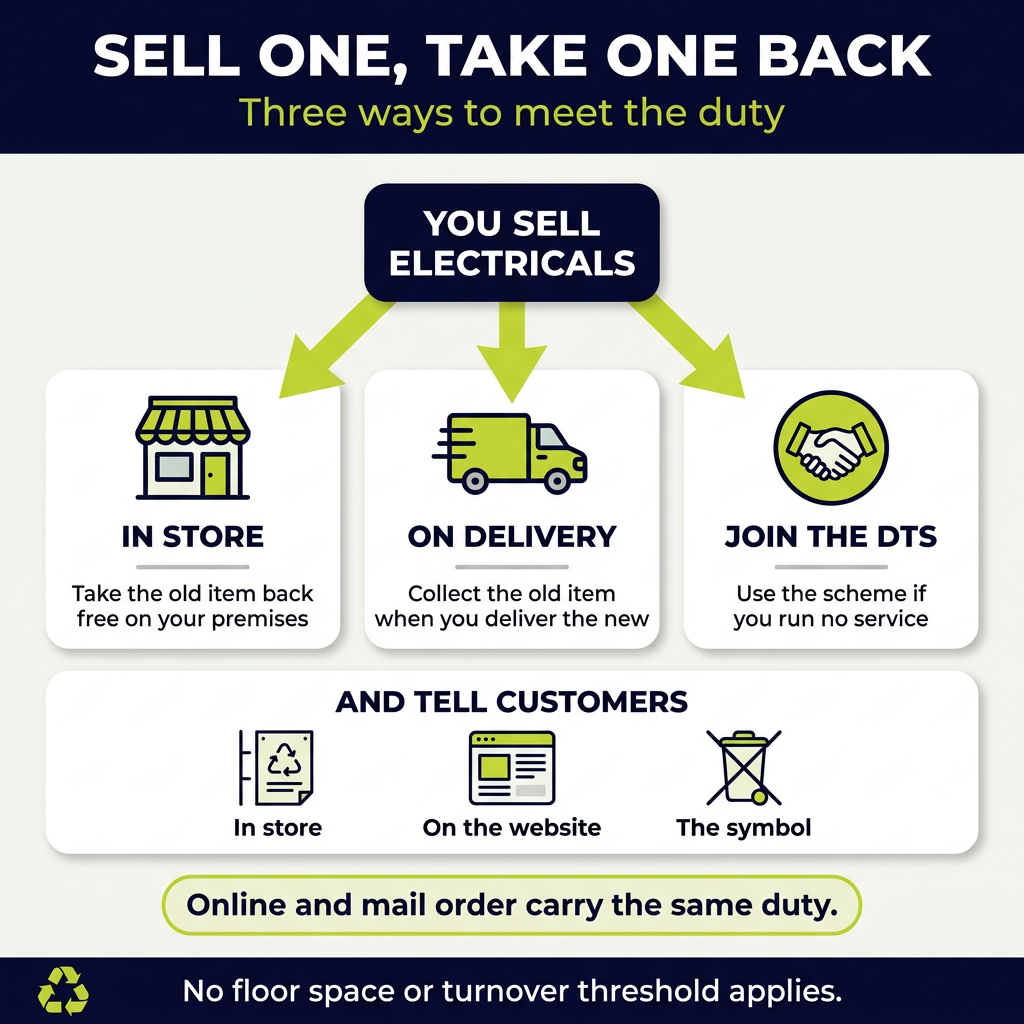
Run in-store take-back. Accept the old item free on your premises. Simple for a shop with space.
Offer an alternative free take-back service. A collection on delivery is the common version, and it suits appliance and furniture retailers.
Join the Distributor Take Back Scheme. If you do not run your own take-back, you must join the DTS. It funds collection facilities in place of you handling items directly.
Most small retailers pick the scheme. Most appliance retailers pick collect-on-delivery, because the van is already going.
The information duty people forget
Take-back is only half the obligation. The other half costs nothing and gets missed again and again.
Tell customers which service you offer. Including whether you collect on delivery.
Explain reuse and recycling. What happens to the item after it leaves them.
Say why separate collection matters. And what the environmental risk is if it does not happen.
Explain the crossed-out wheelie bin symbol. The one on the back of every appliance.
Provide it free and in writing. Online sellers publish it on the website. Physical shops can use a poster or a leaflet.
A poster by the till and a page on the site covers most of this in an afternoon.
Online sellers are not exempt
This is the most common misreading of the rules, and it is worth being blunt.
Selling by internet, mail order or telephone changes nothing. The obligation follows the sale, not the shop floor.
No premises does not mean no duty. You still need a free route, and you still need the information published.
Marketplace sellers are in scope too. If you sell the equipment, you are the distributor.
The information has to be on the website. Not in a PDF nobody can find.
Small online retailers are the group most likely to be non-compliant without knowing it.
What take-back means for your own waste
Run in-store take-back, and you have created a waste stream in your own building. Plan for it.
It accumulates faster than expected. Above all on appliance and lighting lines.
It needs somewhere sensible to sit. Not the back corridor, not by the fire exit.
Some of it is hazardous. Fluorescent tubes and lamps carry mercury. Fridges carry refrigerant gas.
Batteries need their own container. A returned device with a swollen cell is a fire risk in your stockroom.
It falls under your duty of care. Use a licensed carrier and a transfer note, like any other waste.
We supply containment for this job, and collect the accumulated stream as mixed WEEE.
Sorting what comes back
Returned items are a mixed bag by definition. Four categories cover almost all of it.
Standard small electricals. Kettles, toasters, radios, chargers. Straight to mixed WEEE.
Items with batteries. Cordless tools, shavers, toys, wireless peripherals. Separate battery route.
Lamps and tubes. Hazardous, mercury-bearing, separate containment. Our guide to lamp recycling covers it.
Cooling appliances. Fridges and freezers need degassing before anything else happens to them.
Sort at the point of receipt. Sorting a full cage six weeks later takes far longer.
Give staff one line per category on a laminated card by the cage. It saves the argument every time.
Where this overlaps with producer duties
Distributors and producers are different roles, and many businesses are both without realising.
Selling equipment makes you a distributor. That is the take-back duty described here.
Importing or rebranding makes you a producer. That is a separate registration obligation with its own deadlines.
A shop that imports its own-label range is both. Two sets of duties, two sets of paperwork.
The thresholds differ. Take-back has no volume threshold. Producer registration does.
If you put your own name on anything electrical, read the producer rules as well as these.
A short compliance check
Six questions. If you can answer all six, you are in reasonable shape.
- Do we sell any equipment that runs on mains power or a battery?
- What free route do we offer customers for the old item?
- If we have no route of our own, have we joined the Distributor Take Back Scheme?
- Is the customer information published where people will actually see it?
- Where do returned items go in our building, and who empties that?
- Do we hold transfer notes for the waste that leaves?
Question four catches most retailers. Question five catches the rest.
Work through them with whoever runs the shop floor, not just head office. The answers often differ by site.
Frequently asked questions
Which businesses have a WEEE take-back obligation?
Any business that sells electrical or electronic equipment to customers. That includes shops, trade counters, websites, mail order and telephone sales.
There is no floor-space or turnover threshold in the guidance.
What does like-for-like take-back mean?
The customer can return an old item of the same type as the new one they are buying. A washing machine for a washing machine.
It does not oblige you to accept unrelated equipment somebody brings in.
What is the Distributor Take Back Scheme?
It is an alternative for retailers who do not run their own take-back. Joining the scheme meets the obligation in place of handling returned items yourself.
If you have no take-back service of your own, you must join it.
Do online retailers have to offer take-back?
Yes. The rules apply regardless of how you sell, so internet, mail order and telephone sales all carry the same duty.
Online sellers must also publish the customer information on their website.
What information do we have to give customers?
Which take-back service you offer, reuse and recycling information, and why separate collection matters. Add the environmental risks of not recycling and the meaning of the crossed-out wheelie bin symbol.
It must be free and in writing. A poster works in store; a web page works online.
What do we do with the items customers bring back?
Store them sorted by type, then have a licensed carrier collect them under a waste transfer note.
Keep lamps, cooling appliances and anything containing a battery separate from general small electricals.
Does take-back apply if we only sell to businesses?
The household take-back rules target consumer sales. Business-to-business supply follows its own arrangements over who finances disposal.
If you sell to both, look at each channel separately rather than assuming one answer covers you.
The bottom line
Take-back is a small obligation that a great many retailers have never actioned.
Decide your route first: your own free service, or the Distributor Take Back Scheme.
Then publish the customer information where somebody will actually find it, because that is the part inspections pick up.
And plan where returned items sit in your building, with lamps, cooling appliances and batteries kept apart from the rest.
Priority WEEE collects take-back returns from retailers across the UK, with sorted containment supplied and full waste transfer documentation. Book a free waste review, and we will set up the back-of-store side.
Source: GOV.UK, electrical waste: retailer and distributor responsibilities
