
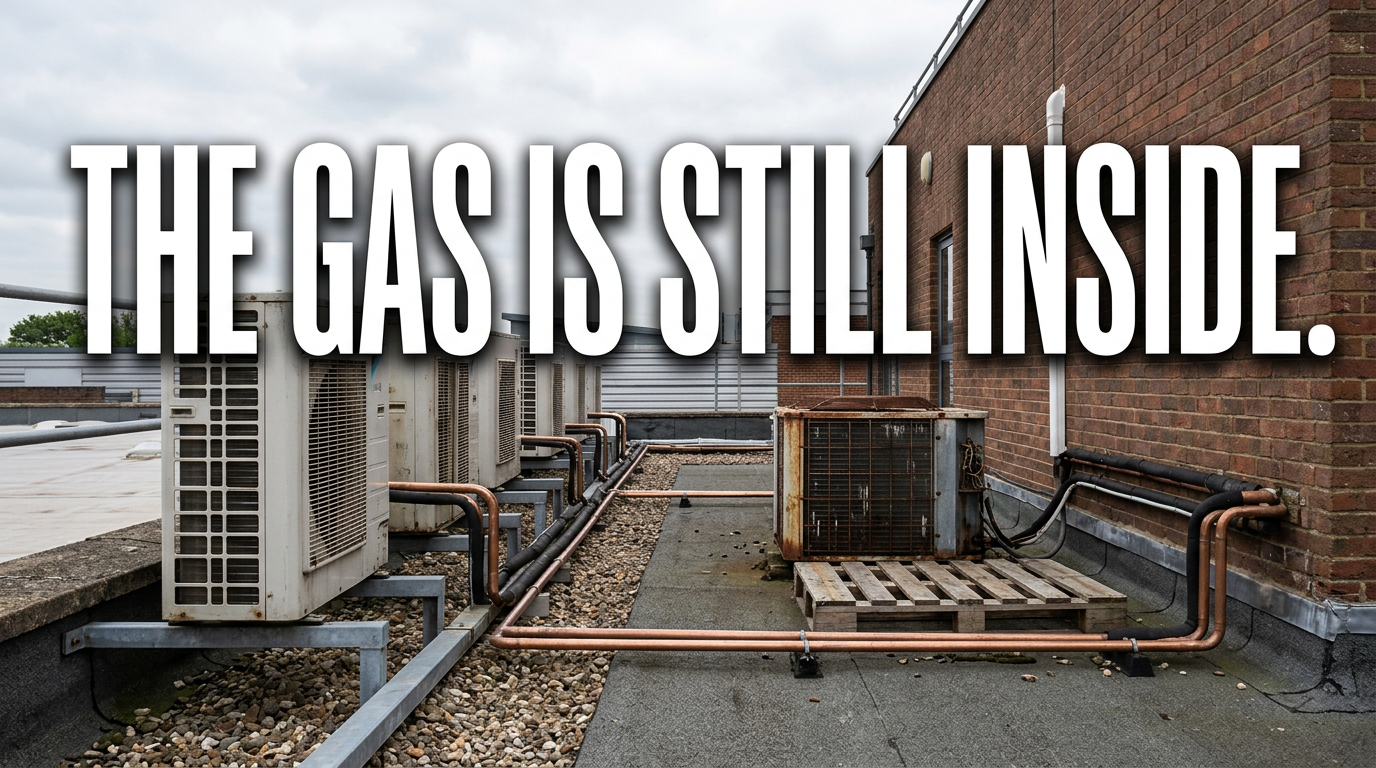
The old air con unit on the back wall stopped working two summers ago.
The fit-out team wants it gone by Friday. Someone suggests cutting the pipes and lifting it off the brackets.
Stop there. That unit still holds a charge of refrigerant gas, and the gas has to come out first.
What is inside an air con unit
An air conditioning system moves heat with a refrigerant. The gas circulates through sealed pipework between the indoor and outdoor parts.
Most units fitted in the last twenty years use fluorinated gases, known as F-gases. Common examples include R410A and R32.
These gases do not harm the ozone layer. They do trap heat in the atmosphere, many times more strongly than carbon dioxide.
Older units may hold HCFC gases such as R22. These deplete the ozone layer as well, so they carry their own strict rules.
You cannot tell which gas a unit holds by looking at it. Check the rating plate on the outdoor condenser, or ask an engineer.
The size of the charge varies with the system. A small wall unit holds far less gas than a rooftop condenser serving a whole floor.
The rules in plain terms
UK F-gas rules set out who can handle refrigerant and what they must record. Ozone-depleting gases fall under their own separate controls.
The core duty is simple. Before anyone removes or dismantles a unit, a suitably certified person must recover the gas.
That person needs the right F-gas certification for the work. A general electrician or a removals crew does not qualify.
The duty usually sits with the business that owns or controls the unit. Hiring a contractor for the strip out does not pass that duty on.
Releasing refrigerant on purpose is against the law. The rules change over time, so check the current position with the Environment Agency or your relevant regulator.
Never vent and never cut
The quickest way to break the rules is to cut the pipework.
A cut line releases the whole charge in seconds. You cannot recover it once it has gone.
Do not cut, crimp or unbolt refrigerant lines. Leave the system sealed until the engineer arrives.
The same goes for loosening valves to “let it down”. That is venting, even if nobody meant harm.
Mention this in the site induction for any strip out crew. A team working against the clock is the one most likely to reach for the cutters.
Some newer heat pumps use propane, known as R290. It is flammable, so cutting or heating those lines adds a fire risk on top of the gas loss.
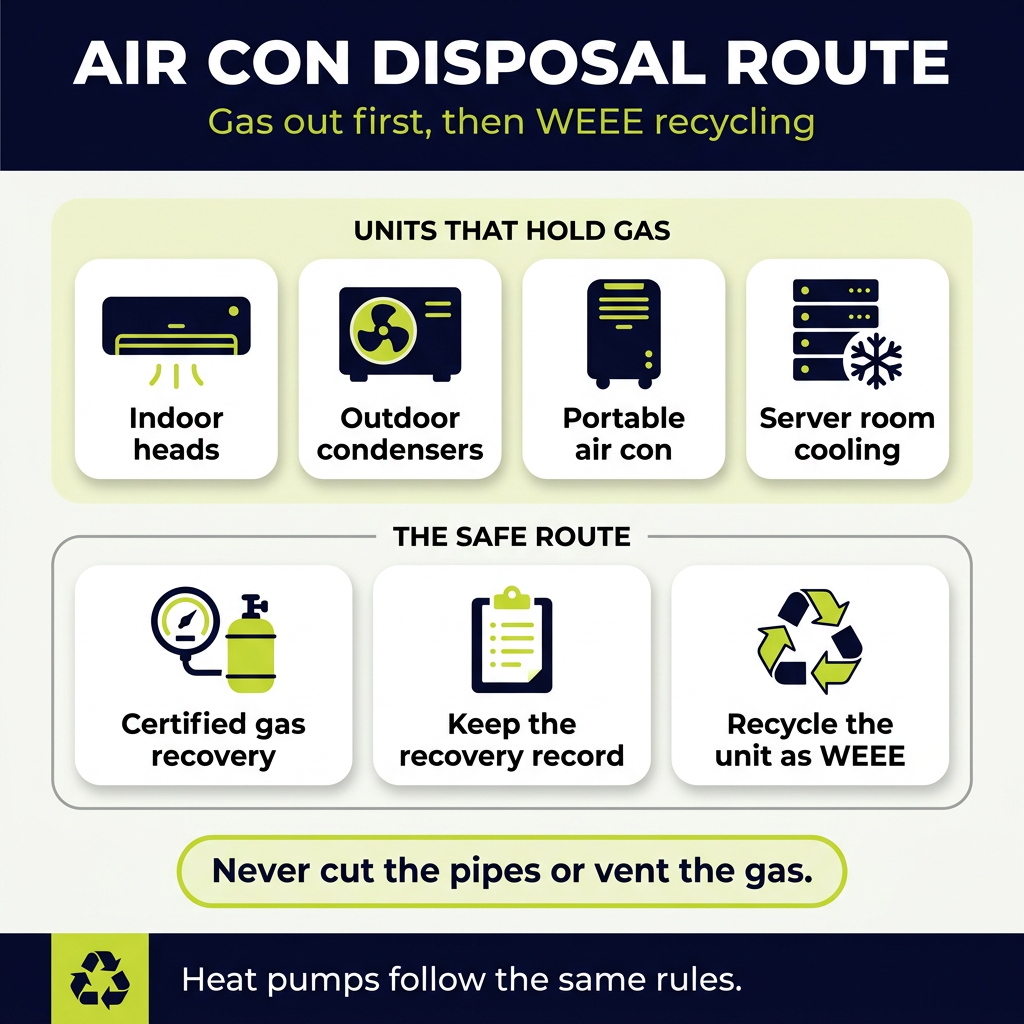
Every type of unit counts
Air conditioning in a business rarely means one box on a wall.
Split systems. An indoor head sits in the room, and an outdoor condenser sits on the wall, roof or ground. Both parts connect by refrigerant pipework.
Multi-split and ceiling cassettes. One condenser may feed several indoor units across a floor. The gas sits in all of them and in the pipes between.
Portable air con units. These look like appliances, but they hold a sealed refrigerant circuit too. Do not drop them in a skip.
Server-room cooling. Close control units and in-row coolers often hold larger charges. Plan them into any server room decommissioning from the start.
Heat pumps. Air source heat pumps work the same way in reverse. They hold refrigerant and need the same recovery.
Heat pumps are coming through in numbers
More businesses now heat their buildings with air source heat pumps. Schools, offices, care homes and new industrial units all fit them.
Many replace gas boilers. Others replace older air con systems that can heat as well as cool.
Those heat pumps will reach the end of their life too. When they do, they follow the same path as an air con unit.
Plan for it now. Add each heat pump to the asset register with its gas type, charge size and install date.
Ask your installer which gas each model uses. Some heat pumps arrive as sealed monobloc units, with all the refrigerant inside the outdoor box.
The paperwork that proves it
Gas recovery leaves a paper trail, and you need to keep it.
Ask the engineer for a recovery record. It should show the gas type, the amount recovered and the date.
It should also show where the recovered gas went. Some goes for reclaim, and the rest goes for destruction.
Keep this alongside the service and leak check history for the unit. Ask your engineer how long the current rules say to keep each record.
Then keep the waste paperwork for the unit itself. Your collector will issue a waste transfer note, or a consignment note if the waste counts as hazardous.
Ask the collector to confirm the classification before collection day. If the unit still holds gas, say so clearly.
After the gas comes out
Once the gas is out, the unit is WEEE, the same as any other electrical equipment.
The condenser holds copper, aluminium and steel. The compressor may still hold oil, and the circuit boards hold small amounts of precious metal.
A treatment site strips and separates all of this. The metals go back into manufacturing.
Recovery takes out the gas, but some oil may stay behind. Keep units upright where you can, and stop anyone cutting into the compressor.
Indoor heads, remote controls and wall controllers follow the same route. Group them with the rest of your mixed WEEE where it makes sense.
Where fridges come in
Fridges and freezers hold refrigerant too, and they follow very similar rules.
Water coolers, ice machines and display chillers sit in the same family. Each one holds a refrigerant circuit and needs the same care.
If you are clearing a kitchen or a whole building, deal with both at once. Our guide to fridge freezer disposal covers the cold appliances in detail.
Our fridge decontamination and fridge recycling services handle the gas and the cabinets. Ask us how air con units fit into the same collection.
Getting ready for collection
A little planning on site saves a lot of delay.
List every unit. Note the type, location and gas type from the rating plate, if you can read it.
Photograph each rating plate before removal. It saves guesswork if the label gets damaged on the way down.
Book the engineer for gas recovery before the strip out team arrives. Agree who disconnects the power and who lifts the units down.
Store recovered units somewhere dry and secure until collection. Our guide to WEEE storage and containment explains how to keep them in good order.
Have access, keys and lifting kit ready on the day. Our guide to preparing for a compliant WEEE collection covers the checklist.
For refurbishment projects in hotels and restaurants, see our guide to refurbishment WEEE as well.
Frequently asked questions
Can I put an old air con unit in a skip?
No. It holds refrigerant gas, and a certified engineer must recover it first. After that, the unit goes for WEEE recycling.
Who can remove the refrigerant gas?
Only someone holding the right F-gas certification for that work. Ask to see their certificate before the job starts.
Do portable air conditioners count?
Yes. They hold a sealed refrigerant circuit, so they need the same care. Do not pierce or crush them.
What if the unit is old and uses R22?
R22 is an ozone-depleting gas, and it carries strict controls. A certified engineer still recovers it, and the record matters even more.
Are heat pumps treated the same way?
Yes. A heat pump holds refrigerant just like an air con unit, so it needs gas recovery before removal.
What records should we keep?
Keep the engineer’s recovery record and the waste transfer or consignment note. Store them with the unit’s service history.
The bottom line
An old air con unit is a sealed box of gas with a metal shell around it.
Never cut the pipes or vent the system. Book a certified engineer to recover the gas, and keep the record they give you.
Then send the stripped unit for WEEE recycling, along with the indoor heads and controls. Plan the same route for your heat pumps now.
Priority WEEE collects air conditioning units, heat pumps and refrigerant equipment from sites across the UK. Book a free waste review, and we will start with the unit on the back wall.
