

A business installs eight charge points in the staff car park. It is a good decision, and everybody treats it as a permanent one.
It is not. Charge points are electrical equipment on a post, out in the weather. People in a hurry handle the connectors several times a day.
They fail, they get damaged, and the technology moves. Within a few years, some of those units come out of the ground. Almost nobody has thought about where they go.
A charge point is WEEE like anything else
Bolting it to a car park changes nothing about its classification.
It runs on mains power. That makes it electrical and electronic equipment.
It holds control electronics. Circuit boards, metering, contactors and communications modules.
It holds a network connection. That means configuration data and sometimes user records.
It carries significant copper. In the cabling, the connectors and the internal wiring.
So it leaves site under the same rules as a server. Not as building rubble, and not in the groundworks skip.
The post and the concrete are a different matter. The unit on top of them is not.
Why units come out sooner than expected
People assume a twenty-year asset. The real life is shorter, for reasons that have nothing to do with build quality.
Connectors and cables take the wear. Daily handling, dropped guns, cables driven over.
Vehicle impact. Car parks and bollards have a well-known relationship.
Weather and vandalism. Outdoor equipment in an unsupervised location.
Charging speeds move on. Units installed a few years ago look slow beside current expectations.
Back-end platforms change. Pull the management platform and the unit can become dead weight.
Sites change use. A relocation or a lease end strands the whole installation.
Any of these takes a unit out of service well before its physical life ends.
Two or three at once is common. A damaged unit on an ageing platform rarely gets repaired.
The three streams inside one installation
Taking out a charging bay produces more than a post.
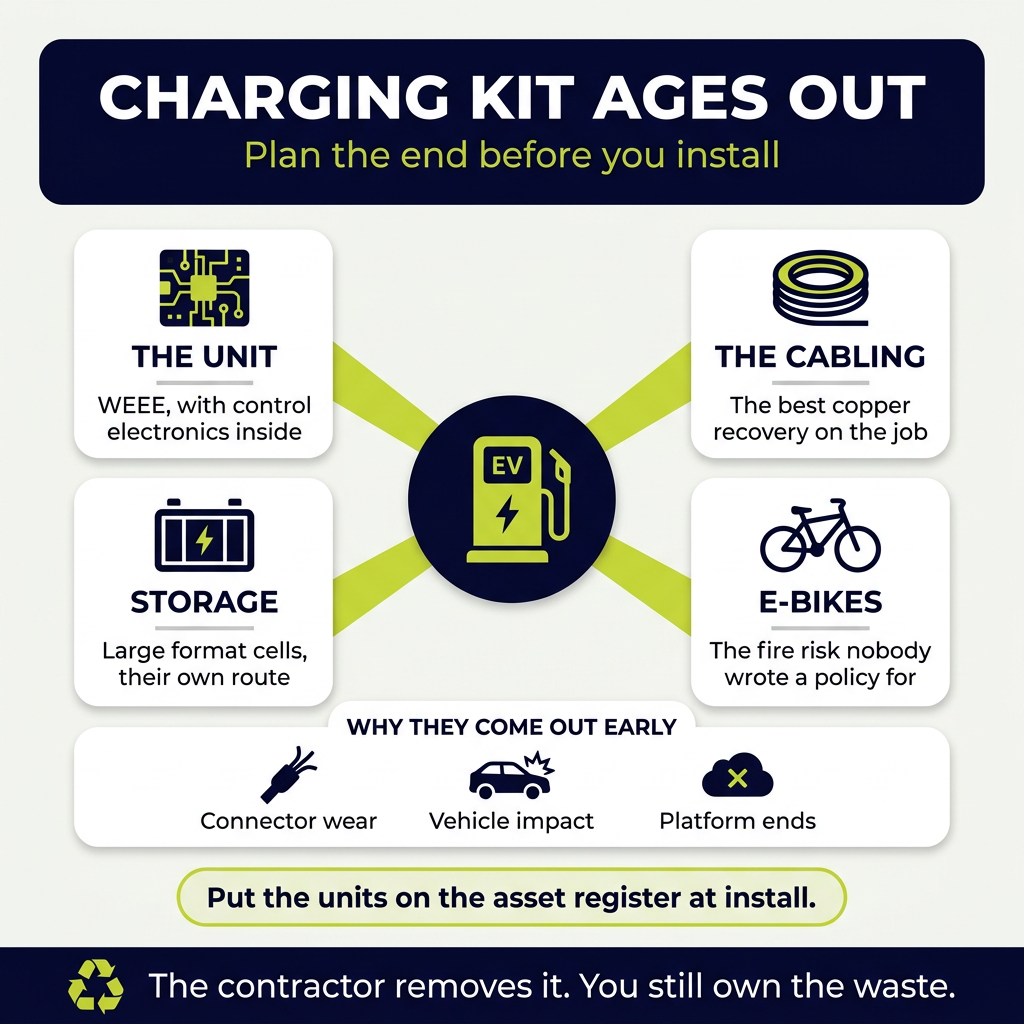
The charge unit itself. WEEE, with control electronics and a communications module.
The cabling and groundworks. Substantial copper content, handled apart from the unit.
The supporting infrastructure. Distribution boards, isolators, metering and any local battery storage.
That last item matters. A site with battery storage behind its chargers has a significant battery disposal job attached, not a minor one.
E-bikes and e-scooters are the sharper risk
Fleet charge points are a planning problem. Workplace e-bikes are a fire problem, and they arrive without anyone deciding.
Staff bring them in. Through cycle-to-work schemes and their own purchases.
They charge wherever there is a socket. Corridors, storerooms, under desks.
The batteries are large. Far more energy than a laptop or a phone.
Damaged cells are common. Bikes get dropped, and the battery takes the impact.
Nobody owns the policy. Until there is an incident, at which point everybody does.
Our guide to business battery fire risk covers the details. The disposal route is separate from general WEEE and needs its own containment.
Setting a workplace charging policy
Short, practical and worth writing before you need it.
Name where charging happens. One location, not wherever there is a socket.
Keep it away from escape routes. Not a corridor, not a stairwell, not by the only exit.
Set a rule on damaged batteries. Swollen, dented or dropped cells do not get charged, and they leave the building that day.
Provide somewhere to put a dead battery. Otherwise, it lives in a locker.
Cover contractor and delivery bikes too. They charge on your premises as well.
We supply fire-retardant containment sized for large format cells.
Write the policy on one side of paper. A long document nobody reads protects nobody.
Fleet vehicles bring their own electronics
Beyond the chargers, a fleet generates a steady stream of small electrical waste that nobody logs.
- Telematics units and tracking devices
- Dashcams, which hold footage and count as personal data
- Handheld terminals, scanners and printers
- Two-way radios and chargers
- Tail lift and refrigeration control units
- In-cab tablets and mounts
- Auxiliary batteries and jump packs
Dashcams and telematics hold location history, so they need data destruction rather than a scrap bin. Our asset management service tracks these alongside IT equipment.
Plan the end at installation
The cheapest moment to solve this comes before anyone digs.
Put the units on the asset register. With model, serial, location and install date.
Record the management platform. So you know what a withdrawal would mean.
Ask the installer about decommissioning. Before signing, not five years later.
Check the lease position. On a leased site, who owns the installation at the end?
Budget for removal. Groundworks are not free, and neither is making good.
Agree who handles the WEEE. The electrical contractor removes. Removal is not disposal.
That last line is the one that catches people out on every kind of fixed equipment.
It applies to solar arrays, signage and access control just as much as to chargers.
What comes back out of it
Worth knowing, because the recovery is better than most people assume.
Copper from cabling and connectors. The largest single value in the installation.
Circuit boards. Small volume, high value, recovered through specialist treatment.
Steel and aluminium from housings and posts. Plain scrap once it comes apart.
Lithium from any battery storage. Recovered through the battery route.
None of that survives a mixed skip. Our guide to what actually comes out of recycled electronics covers the process.
Frequently asked questions
Are EV charge points classed as WEEE?
Yes. A charge point runs on mains power and holds control electronics, which makes it electrical equipment at end of life.
A post in a car park is still equipment, not building material.
How long do charge points last?
Shorter than most businesses assume. Connector wear, vehicle impact, weather, changing charging speeds and withdrawn management platforms all take units out of service early.
Budget for replacement well inside the design life.
What happens to the cabling?
It carries substantial copper and needs pulling out rather than going with the groundworks.
Clean cable is one of the better recoveries on a decommissioning job.
How should workplaces handle e-bike batteries?
Name one charging location away from escape routes. Set a rule against charging damaged or swollen cells, and provide a fire-retardant container for dead batteries.
Cover contractor and delivery bikes as well as staff ones.
Do dashcams and telematics units need data destruction?
Yes. Both hold location history, and dashcams hold footage, which is personal data.
Treat them like any other data-bearing device and ask for a certificate.
Who is responsible when a contractor removes the chargers?
You are. The electrical contractor removes the equipment, but removal is not disposal, and your duty of care follows the waste.
Agree who handles the WEEE stream before the work starts.
What should we do at installation to make this easier?
Put the units on the asset register and record the management platform. Ask the installer about decommissioning, check the lease position and budget for removal.
Five minutes at installation saves a difficult conversation years later.
The bottom line
Charging infrastructure is electrical equipment with a shorter life than its concrete suggests.
Put the units on the asset register at installation, with the management platform recorded next to them.
Pull the cabling out when they come, because the copper is the best recovery on the job.
Then deal with e-bikes before an incident forces it, because that is the part of this with a fire attached.
Priority WEEE collects charge points, fleet electronics and large format batteries from sites across the UK. Fire-retardant containment is supplied, with certified data destruction. Book a free waste review, and we will start with the car park.
