
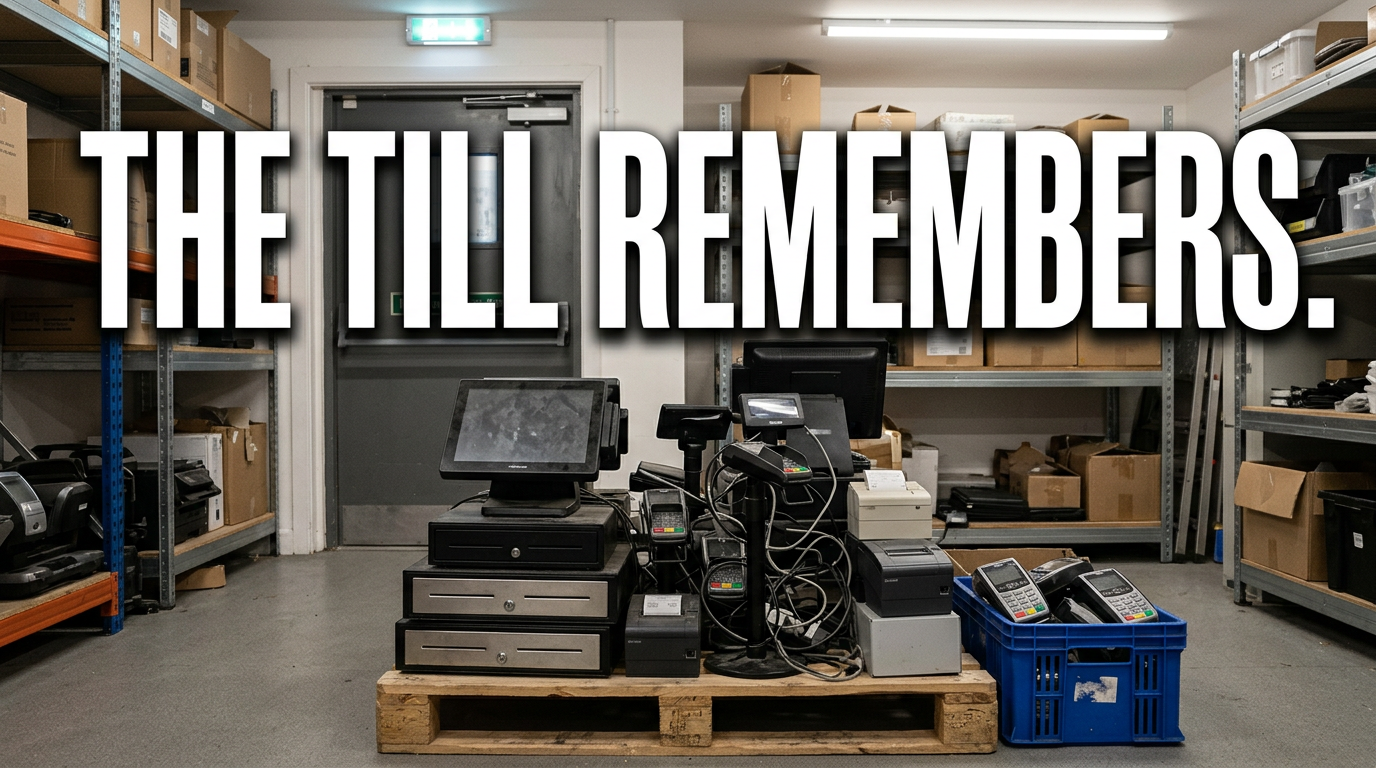
The new tills arrived on Monday. The old ones are in the stockroom, stacked on a pallet by the back door.
Each one still powers on. Each one still knows who worked the late shift, what they sold and which cards paid for it.
That pallet is a data store, a contract question and a WEEE load, all at once.
What an old till actually holds
A modern EPOS terminal is a small computer with a touchscreen. Most have a solid state drive or flash storage inside the case.
That storage keeps far more than the price list. It holds transaction logs, refunds, voids and end of day reports.
It holds staff logins, PIN codes and clock-in records. Some systems store loyalty members, delivery addresses and phone numbers too.
Many tills sync to the cloud, so managers assume nothing stays local. In practice, most keep a local copy so they can trade offline when the internet drops.
The back office PC or server that runs the till system holds even more. It often keeps months of sales history, supplier details and staff records.
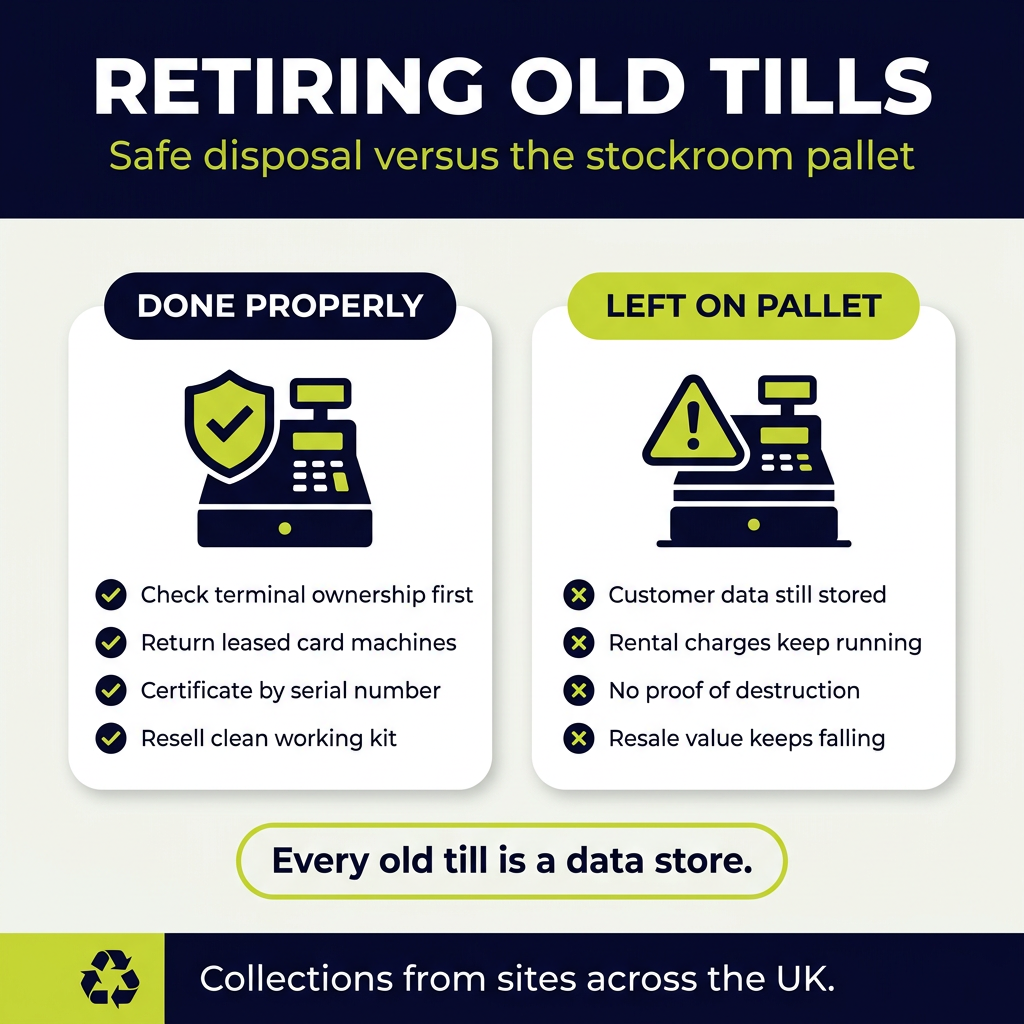
So treat every till as a data-bearing device. Under UK GDPR, the customer and staff records on it are your responsibility until you can prove they are gone.
Card terminals may not be yours to bin
Card terminals, often called PDQ machines or PEDs, follow a different route.
Check who owns the terminal first. Many businesses rent or lease them from a payment provider or merchant acquirer. Others bought them outright.
If the provider owns it, the contract usually sets out a return route. Some send a prepaid bag or arrange a courier.
Throw a leased terminal into a WEEE cage and you may face a charge for unreturned kit. You may also keep paying rental on a device you no longer have.
Find the contract, note the terminal ID and serial number, and ask the provider how they want it back. Get that answer in writing.
Some providers reset the terminal remotely before you post it back. Ask them to confirm that, and keep the reply with your records.
Owned terminals are yours to dispose of. They still need a secure data route, because they sit at the heart of the card payment chain.
What PCI DSS expects at end of life
If you take card payments, you will know the Payment Card Industry Data Security Standard, or PCI DSS.
It expects businesses to destroy cardholder data securely once they no longer need it. That covers any media that may hold it, including drives inside tills and back office PCs.
Well configured systems should never store full card numbers. Older or badly set up software sometimes does, in logs, temporary files or exported reports.
You rarely know for certain which kind you have. So the safe assumption is that the drive needs certified destruction or a verified wipe.
Your acquirer or a qualified security assessor can confirm what your own compliance requires. Keep a record either way, because an assessor may ask for it.
The kit around the till
The till is only the centre of the counter. Around it sits a ring of smaller electrical kit.
Receipt printers often hold a small amount of memory for logos and recent jobs. Kitchen printers in restaurants work the same way.
Cash drawers hold no data, but they contain metal, a solenoid and a cable. They count as WEEE.
Barcode scanners may store recent scans, and cordless models carry lithium batteries. Customer displays, card terminal stands and kitchen screens join the pile too.
All of it belongs in a WEEE route, never in general waste. Our guide to the office drawer full of cables and chargers covers the leads and power supplies.
Most of this kit falls under EWC code 16 02 14 for discarded equipment. Damaged items with hazardous parts may need 16 02 13*, so confirm the code with your collector.
Batteries in portable terminals
Portable card terminals and handheld order pads carry lithium batteries. So do cordless scanners and some tablet tills.
Old batteries swell, and a swollen battery can catch fire if someone crushes or charges it.
Never charge a device with a swollen battery. Set it aside in a fire-retardant container and tell your collector before they arrive.
Our guide to business battery fire risk covers safe storage on site.
Refresh rollouts across many sites
Retail chains and hospitality groups rarely replace one till. They replace hundreds, branch by branch, over a few weeks.
That creates a logistics problem. Old kit sits in stockrooms, cellars and back offices while installers move on to the next site.
Plan the collection alongside the install. Agree a collection window for each site, ideally the day after go-live.
Label every pallet with the branch name and a unit count. That makes the certificate easy to check against each site later.
Give each branch a simple checklist. Power down, unplug, count the units and keep card terminals apart for their own route.
Hotels, pubs and restaurants often refresh EPOS during a wider refit. Our guide to hotel, pub and restaurant refurbishment covers the rest of the strip-out.
Destruction with a certificate by serial number
Every till, back office PC and owned terminal needs a clear end. Either a verified wipe for reuse, or physical destruction of the storage.
Ask for a certificate listing each device by serial number. A single line saying “40 tills” does not prove what happened to till number 17.
Match the certificate against your asset register, site by site. Any gap is a device you cannot account for.
Our guide to data destruction standards explains what a proper certificate includes. Our data destruction service handles both routes, with collection from sites across the UK.
Back office printers and photocopiers often go in the same refresh. Their hard drives need the same care, as our guide to printer and photocopier hard drives explains.
Resale of clean kit
Not every old till is scrap. Branded EPOS hardware often has a second life with smaller retailers and cafes.
Once the storage is wiped and verified, working terminals, printers and cash drawers can go for refurbishment and resale.
Resale value fades with age. A pallet left in a cellar for a year loses money every month.
Keep stands, power supplies and printer covers with the units where you can. Complete sets sell better.
Our guide to IT asset recovery explains how resale offsets the cost of disposal.
Keep the trail in one register
The real fix is a register that follows each device from install to disposal.
Log the serial number, site and install date for every till and terminal. Log the return or collection date when it comes out.
Log the route, the certificate reference and any resale. That gives head office one trail across every branch.
Our IT asset management service tracks EPOS hardware alongside laptops, servers and mobile devices.
Frequently asked questions
Do tills and card terminals count as WEEE?
Yes. They are electrical and electronic equipment under the WEEE Regulations 2013, so they need a WEEE route.
Can we bin a card terminal from our payment provider?
Not until you check the contract. Many terminals belong to the provider, who will expect it back through their own return route.
Do old tills really hold customer data?
Often, yes. Most keep transaction logs, staff logins and sometimes customer details on local storage.
Is a factory reset enough?
No. A reset gives you no proof of erasure. Use a verified wipe or physical destruction, with a certificate.
What about receipt printers and cash drawers?
They are WEEE too. Printers may hold a little memory, so include them in the data route.
Can old EPOS kit be resold?
Often, yes, if it works and the storage is clean. Value drops with age, so arrange collection soon after the refresh.
The bottom line
An old till is a computer full of sales, staff and customer records.
Check who owns each card terminal and return leased ones through the provider. Keep everything else together, with serial numbers logged.
Then choose a verified wipe or destruction. Get a certificate for every device, and resell what still works.
Priority WEEE collects tills, card terminals and counter kit from sites across the UK. Certified data destruction or wiping for resale comes as standard. Book a free waste review, and we will start with the pallet in the stockroom.
